
Spider Control · South East Queensland
Why Vacuuming Spider Webs Won't Stop the Infestation Returning
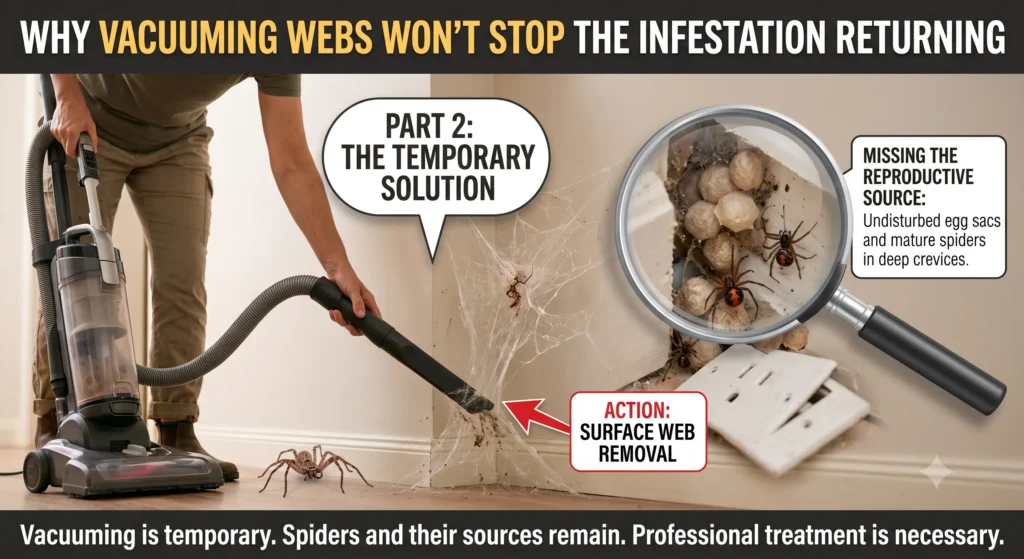
Vacuuming spider webs is a perfectly understandable response to finding them in your home, and it does produce a tidy result — for a few hours. Within days, and often within 24 hours, the webs are back. This cycle repeats indefinitely for one straightforward reason: vacuuming treats the symptom rather than the cause. Understanding why webs return requires understanding why spiders choose your home in the first place and what actually needs to change to stop them coming back.
What vacuuming actually does — and doesn't do
A vacuum cleaner removes a web from a surface. That is the entirety of what it achieves from a pest control perspective. Here is what it does not do:
- It does not kill the spider reliably. Many spiders — particularly Huntsmans — are robust enough to survive the suction and vibration of a standard vacuum. They escape into the bag or canister and, if the vacuum is not immediately emptied into a sealed bag, can re-enter the home.
- It does not destroy egg sacs. Spider egg sacs are constructed from layers of silk that are specifically designed to protect the eggs from physical damage. A vacuum passes over the surface of an egg sac without rupturing it. The sac enters the bag intact, where eggs continue to develop. If the bag is not disposed of immediately and properly, hundreds of spiderlings can hatch inside the vacuum and disperse through your home.
- It does not remove the food source. Spiders are present in your home because there are insects for them to eat. Mosquitoes, moths, flies, cockroaches, and other insects provide the prey that sustains spider populations. Vacuuming a web does not reduce the insect population, so the conditions that attracted the spider remain unchanged.
- It does not create a barrier. Unlike a residual insecticide, a vacuumed surface provides no ongoing deterrent. A new spider entering through a gap in the window or door frame encounters exactly the same environment as before — available prey, suitable harbourage, no chemical deterrent.
The most significant risk of vacuuming without additional treatment is disturbing egg sacs without destroying them. A Redback egg sac contains 40–300 eggs. The papery silk construction is tough enough to pass through a vacuum nozzle intact. If the vacuum bag or canister is not immediately sealed and disposed of, you may inadvertently distribute the egg sac's contents through your home. Always empty the vacuum immediately after web removal and seal the bag in a plastic bag before binning it.
Why webs return: the root causes
Your home provides what spiders need
Spiders are highly practical animals. They locate in any environment that provides three things: prey, shelter, and a surface to anchor a web or a dark recess to hide in. A home in South East Queensland — particularly one with outdoor lighting, garden vegetation close to the structure, and gaps around windows and doors — provides all three in abundance. Removing a web addresses none of these underlying conditions.
Spider populations in SEQ are large and persistent
South East Queensland's warm, humid climate supports year-round spider activity. Unlike colder climates where spider populations reduce dramatically in winter, SEQ homes deal with active spider populations across all seasons. A web removed in one location is simply rebuilt by the same spider or replaced by a different one from the surrounding population.
Common entry points remain open
Spiders enter homes through gaps around pipe penetrations, window frames that don't fully seal, weep holes in brickwork, open vents, and gaps under doors. Until these entry points are addressed, new spiders continuously enter to replace those that have been removed or treated.
Harbourage remains available
Clutter in garages and storage areas, stored timber, cardboard boxes, and garden debris adjacent to the house all provide excellent daytime harbourage for web-building and wandering spider species. While a web in the ceiling corner gets removed, the spider simply retreats to its daytime hiding spot and rebuilds at night.
What actually stops spiders from returning
1. Residual chemical treatment by a licensed pest technician
A professional residual treatment uses pyrethroid-based chemistry applied to all surfaces where spiders travel and build — wall and ceiling junctions, eaves, window and door frames, the external perimeter of the house, garage walls, and roof void entry points where accessible. These products bind to the surface and remain active for months. When a spider walks across the treated surface, it absorbs the product through its legs and dies within minutes to hours. Critically, this effect persists for three to twelve months depending on the product and surface type, meaning new spiders entering the property are killed before they can establish.
2. Web removal as part of treatment
Professional spider treatments include web removal using a cobweb brush prior to chemical application. This is not done because the web removal itself is the treatment — it is done because removing the physical web ensures the residual product contacts the surface directly. A spider that passes through a treated surface is killed; a spider that lives in an existing web above the treated surface may not contact the chemical at all.
3. Reduction of outdoor lighting
Outdoor lights attract insects, and insects attract spiders. Switching floodlights and porch lights to warm-spectrum LED globes, which attract significantly fewer insects than cool-spectrum lights, reduces the insect supply that sustains spider populations around the home. This does not eliminate spiders, but it reduces the population density over time.
4. Habitat modification
Clearing garden beds away from the house walls, removing stored timber and cardboard from garages, and keeping gardens trimmed back from the structure removes daytime harbourage and reduces the spider population that can access your home. Combined with residual treatment, habitat modification significantly extends the interval between treatment applications.
5. Sealing entry points
Foam sealant around pipe penetrations, door seals, and weep hole covers are low-cost modifications that reduce spider entry over the medium term. These measures are particularly effective when combined with perimeter treatment — fewer spiders make contact with the treated surface, and fewer spiders enter the home at all.
Jets Pest Control uses commercial-grade residual spider treatments covering the full property perimeter, eaves, garages, and identified harbourage points. Our treatments include web removal and comprehensive application to all surface junctions. Call 1300 566 569 to book a treatment or request a quote for your property.
The right approach: what to do and what to skip
Do
- Book a professional residual spider treatment annually
- Seal gaps around windows, pipes, and doors
- Reduce outdoor lighting intensity and switch to warm-spectrum globes
- Clear clutter from garages and storage areas
- Keep garden vegetation away from house walls
- Empty the vacuum bag immediately after web removal and seal it
Don't
- Rely on vacuuming alone as a control measure
- Leave vacuumed egg sacs in the bag overnight
- Use consumer aerosol sprays as a substitute for residual treatment
- Ignore webs near Redback-favoured harbourage (furniture undersides, letterboxes, wheel arches)
- Disturb suspected Redback webs bare-handed
- Assume the spider is gone just because the web is gone
When to call a professional instead of vacuuming
If any of the following conditions apply, professional treatment is the appropriate response rather than ongoing web removal:
- You are finding new webs in the same location within 48 hours of removal — this indicates an active, established infestation
- You have identified or suspect a Redback spider — a professional will locate and treat the web, egg sacs, and surrounding harbourage areas
- You have a garage, carport, or outbuilding with heavy web activity — these areas require full perimeter treatment
- You have children or pets who use areas where webs are regularly appearing
- Your property backs onto bushland, creek lines, or heavily vegetated areas — these are high-pressure spider environments requiring regular professional treatment
If you have located a Redback spider web — recognisable by its messy, sticky structure in a dry sheltered spot, often containing one or more papery egg sacs — do not reach in to vacuum it without protection. The spider retreats into the web structure and is not visible. Use a long-handled cobweb brush to remove the web from a safe distance, or contact a pest professional. A Redback bite requires medical attention; if bitten, apply a cold compress and seek treatment promptly.
Frequently asked questions
Why do spider webs keep coming back after I vacuum them?
Does vacuuming kill spiders?
What is the best way to stop spider webs permanently in my home?
How long does a professional spider treatment last?
Can I use supermarket spider sprays instead of calling a professional?
Stop the cycle — book a professional spider treatment
Jets Pest Control provides residual spider treatments covering the full property perimeter, eaves, and garages across Ipswich and South East Queensland.

