
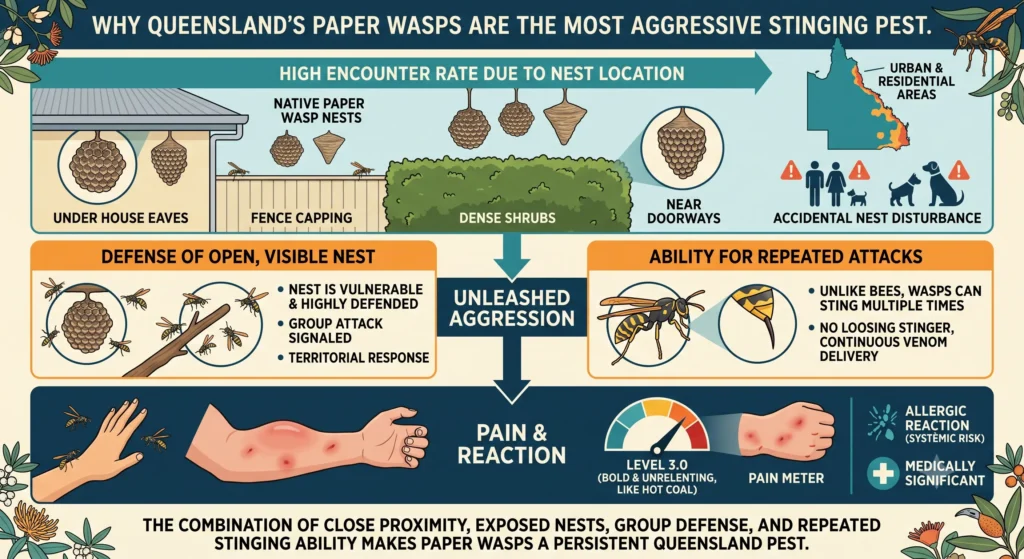
Why paper wasps are the most aggressive stinging pest in Queensland
Jets Pest Control | Ipswich & South East Queensland
Of all the stinging insects found around Queensland homes, paper wasps cause more unprovoked attacks, more emergency presentations, and more anaphylactic reactions than any other species. Unlike European wasps or honeybees, paper wasps will pursue and sting repeatedly — and their nests are built in the places where people live and work every day.
What makes paper wasps different from other stinging insects
Most people understand that bees can sting, but paper wasps occupy a different threat category entirely. A honeybee stings once and dies — the barbed stinger disembowels the bee as it pulls free. Paper wasps have smooth stingers and can sting the same target multiple times in rapid succession without any cost to the wasp.
More critically, paper wasps are highly territorial and respond aggressively to perceived threats. Vibration, shadow passing over the nest, sudden movement nearby, or even carbon dioxide from breathing close to a nest can trigger an alarm response. Once one wasp releases alarm pheromones, nearby colony members join the attack. This cascade behaviour is what makes encounters with established nests so dangerous.
Queensland paper wasp species you need to know
Australian paper wasp (Polistes humilis)
High aggressionThe most commonly encountered species around Ipswich homes. Brown with yellow-orange markings, approximately 15–18 mm in length. Builds open, umbrella-shaped nests from chewed wood pulp. Favours sheltered spots under eaves, inside letterboxes, in pergola roofs, and behind external light fittings. Colonies of 20–100 wasps. Extremely defensive when the nest is approached.
Yellow paper wasp (Polistes tepidus)
High aggressionLarger than the Australian paper wasp at 20–25 mm, with bright yellow and brown banding. Found predominantly in northern and central Queensland but increasingly present in South East Queensland. Builds larger colonies than P. humilis and is considered the more aggressive of the two common species. Nests in similar locations to the Australian paper wasp but also frequently found inside wall cavities accessed through weep holes.
Asian paper wasp (Polistes chinensis)
Moderate aggressionAn introduced species now established in South East Queensland. Slightly smaller than native paper wasps, with distinctive brown and pale yellow patterning. Notable for building larger colonies than native species — nests of 200+ workers are not uncommon by late summer. Competes with and displaces native paper wasps. Still poses the same multiple-sting risk as other species.
Why Queensland's climate makes paper wasps worse
Paper wasp colonies in colder climates die back almost entirely in winter, with only mated queens surviving to found new colonies in spring. Queensland's subtropical and tropical climate disrupts this cycle. In South East Queensland, colonies can persist year-round in sheltered locations, building larger populations and maintaining aggression through what would be the off-season in other states.
The combination of warm winters, abundant food sources (insects and caterpillars for larvae, nectar for adults), and Queensland's building styles — homes with wide eaves, timber pergolas, exposed beam rooflines — creates ideal conditions for paper wasp establishment close to human activity.
Paper wasp activity peaks in Queensland from September through April. Colonies are at maximum size — and maximum aggression — in late summer (January to March). Nest removal attempts during peak season carry the highest risk. If you discover an active nest, do not approach it until you have a plan.
Where paper wasps nest on your property
Paper wasps specifically seek locations that are sheltered from rain, partially concealed, and close to foraging areas. Common nest sites around Queensland homes include:
- Eaves and soffits — the most common location; nests attach to the underside of the eave overhang
- Inside letterboxes — a consistent problem in Queensland; wasps enter through the slot and build on the interior ceiling
- Pergola and deck roofs — especially exposed beam pergolas where the structure provides attachment points on multiple surfaces
- Behind external light fittings — the warm microclimate and shelter attracts nesting activity
- Roller door tracks — common in sheds and garages; the horizontal track provides a sheltered, rarely disturbed surface
- Inside play equipment — slide tubes, hollow climbing structures, and swing frames are regularly infested
- Weep holes in brick walls — entry points into wall cavities where nests can grow unseen until they become very large
- Under outdoor furniture — the underside of table tops and chair rails are used for smaller satellite nests
Understanding paper wasp sting severity
Paper wasp venom contains a mix of enzymes, peptides, and biogenic amines that cause immediate localised pain, swelling, and redness. For the majority of people, a single sting causes significant discomfort that resolves over several hours to a few days. The concern is with multi-sting attacks and with individuals who develop an allergic sensitisation.
| Reaction type | Symptoms | Action required |
|---|---|---|
| Normal local reaction | Pain, redness, swelling at sting site — resolves within hours | Clean the area, apply cold compress, monitor |
| Large local reaction | Swelling extending beyond the sting site, lasting 24–48 hours | Antihistamine, cold compress, seek advice if severe |
| Systemic allergic reaction | Hives, itching, or swelling away from the sting site | Seek medical attention promptly |
| Anaphylaxis | Difficulty breathing, throat swelling, drop in blood pressure, collapse | Call 000 immediately — life-threatening emergency |
Prior sting reactions do not predict future reactions. A person who has been stung without serious reaction can develop anaphylaxis on a subsequent sting — sensitisation builds with exposure. If you or anyone in your household has previously had a systemic reaction to any insect sting, carry an adrenaline auto-injector (EpiPen) and consult your GP about venom immunotherapy. If someone is stung and shows any sign of systemic reaction, call 000 immediately — do not wait to see if symptoms worsen.
When paper wasps attack: triggers to avoid
Paper wasps do not attack without reason, but their threshold for perceived threat is very low. The following behaviours near an active nest are likely to trigger an attack:
- Vibration — lawnmowing, using a trimmer, hammering, or operating power tools near a nest sends vibration through the structure the nest is attached to
- Airflow — blowing air toward the nest, including from leaf blowers or spray cans, triggers immediate defensive response
- Shadow passing over the nest — paper wasps track overhead movement as a predator cue
- Disturbing the nest directly — even accidental contact, such as reaching behind an outdoor light fitting or into a letterbox without checking
- Scent triggers — strong fragrances, including floral perfumes and some sunscreens, can attract or agitate foraging wasps
- Bright clothing or patterns — bold floral patterns in particular can confuse foraging wasps
Can you remove a paper wasp nest yourself?
Small, early-season nests with fewer than ten cells and no adult wasps present can often be knocked down with a long-handled tool and the area treated with a residual spray. However, any nest with adult wasps present carries a meaningful risk of multi-sting attack, and DIY removal is the most common cause of paper wasp injury in residential settings.
Consumer aerosol wasp sprays have a range of two to three metres and require the operator to be close enough to hit the nest entrance directly. A miss, or a sting that causes flinching, can result in the operator receiving multiple stings before they can retreat. Paper wasps can fly at speeds exceeding 20 km/h.
Common advice about treating nests at night is based on European wasp behaviour, where night-time application can be effective. Paper wasps are more active and more aggressive in warm Queensland evenings. Attempting nest removal at dusk on a warm night in Queensland is particularly dangerous — the colony is still active and the reduced visibility makes evasion difficult if attacked.
How professional paper wasp treatment works
A licensed pest technician treats paper wasp nests using a combination of direct application insecticide and residual spray to prevent re-establishment. The approach differs from DIY methods in several key ways:
- Professional-grade dusts and aerosols — penetrate nest cells and kill returning wasps over 24–72 hours, rather than just contacting wasps present at the time
- Correct application distance — commercial equipment allows treatment from a safe distance without approaching the nest
- Residual surface treatment — applied to the attachment point after nest removal to deter re-nesting in the same location
- Full property inspection — identifies satellite nests and secondary colonies that may not be obvious to the homeowner
- Safe access to difficult locations — rooflines, high eaves, and wall cavity nests require appropriate equipment and technique
What to do if you are stung
- Move away from the nest area immediately — do not stop to treat the sting while you are still near the colony
- Get indoors or into a vehicle to prevent additional stings from pursuing wasps
- Remove any wasp that is still attached by brushing it off — do not squeeze, as this releases more venom
- Wash the sting site with soap and water
- Apply a cold compress to reduce swelling and pain
- Take an oral antihistamine if available and you have no contraindications
- Monitor closely for 30 minutes for signs of systemic reaction — call 000 if any symptoms extend beyond the sting site
Do
- Check letterboxes, eaves, and pergolas before reaching in
- Wear long sleeves and close-toed shoes in the garden
- Call a professional for any nest with adult wasps
- Tell your GP if you've had a systemic reaction previously
- Treat discovered nests promptly — colonies grow rapidly
Don't
- Swat at wasps near a nest — this releases alarm pheromones
- Attempt DIY removal of any occupied nest from close range
- Mow or use power tools near known nest locations
- Leave nests untreated hoping they'll go away on their own
- Assume a small nest poses no risk — early-season colonies are still aggressive
Frequently asked questions
Are paper wasps the same as European wasps?
Do paper wasp nests come back to the same spot every year?
How do I know if a nest is active or abandoned?
Can paper wasps sting through clothing?
Why do wasps seem more aggressive in late summer?
Paper wasp nest on your property?
Jets Pest Control provides safe paper wasp nest removal across Ipswich and South East Queensland. Don't risk a multi-sting attack — let us handle it.

