
Spider Safety · South East Queensland
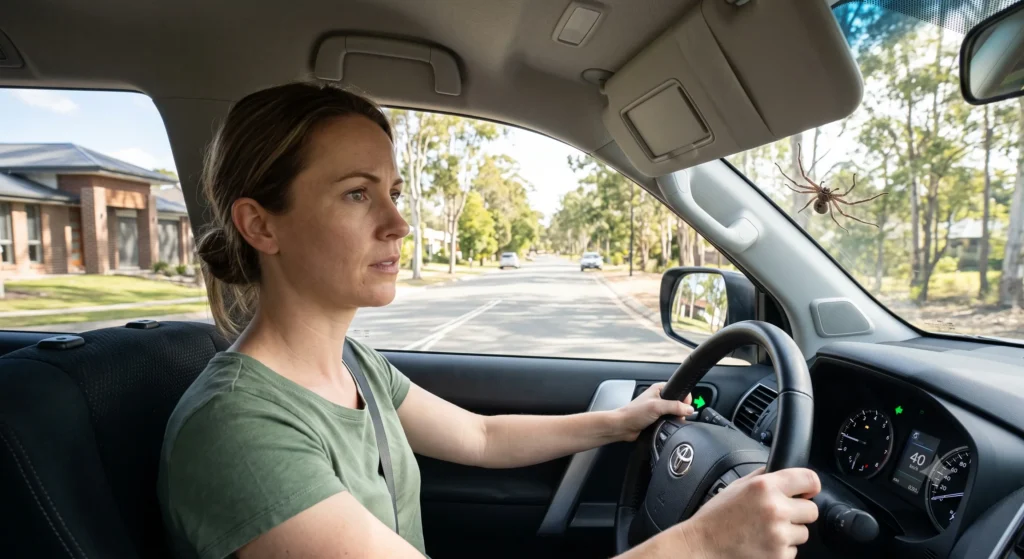
What to Do When a Giant Spider Drops on Your Lap While Driving
A spider appearing suddenly while driving is a recognised road safety hazard. Do not attempt to react while the vehicle is moving. The correct response is: signal, pull over safely, stop the engine — then deal with the spider. This single rule prevents most spider-related traffic incidents.
Why this happens more often than you might think
South East Queensland's warm, humid climate supports year-round spider populations that are significantly more active than those in cooler southern states. Huntsman spiders — the species most frequently found inside car cabins — are nimble, fast-moving, and capable of entering through any window gap larger than approximately 2–3 cm. They are also nocturnal, which means they are most likely to be discovered at the worst possible moment: when you flip down your sun visor on the morning commute, or when the heating comes on and disturbs a spider that settled behind the dashboard overnight.
The experience of a large spider suddenly appearing on the steering wheel, dashboard, or lap while driving at speed is alarming regardless of how composed you might consider yourself. The involuntary startle response — a sudden jerk of the arms, stamping of the feet, or an instinctive attempt to swat the spider — can cause loss of vehicle control in a fraction of a second. Queensland Transport and Main Roads recognises distraction-related incidents as a major cause of crashes, and an in-vehicle spider encounter qualifies as a significant distraction event.
This guide covers exactly what to do in the moment, what not to do, and how to reduce the likelihood of it happening again.
The immediate response: step by step
If a spider appears while you are driving, the following sequence applies regardless of the spider's size or species:
-
Stay calm and maintain vehicle control
The spider is not attacking you. It is disoriented and as alarmed as you are. Your priority in the first two seconds is to keep both hands on the wheel, both feet in appropriate position, and your eyes on the road. Resist every instinct to swat, grab, or look away from traffic to find the spider.
-
Signal and move to the left
Check your mirrors, indicate left, and begin moving toward the kerb or the nearest safe stopping point. Do not brake hard or swerve — move to the left lane calmly and progressively. If you are on a motorway, use the emergency stopping lane. If you are in suburban traffic, pull up to the kerb at the next opportunity.
-
Stop the vehicle and turn off the engine
Apply the handbrake, put the vehicle in park or neutral, and turn off the engine. This is important — a running engine and the vibration it creates can agitate the spider and cause it to move unpredictably. Turning the engine off also gives you a moment to breathe before dealing with the spider.
-
Identify the spider if you can do so safely
Before reaching toward the spider or trying to remove it, take a moment to identify what species you are dealing with. A Huntsman spider — large, flat, fast-moving, with a legspan up to 15 cm — poses virtually no medical risk. A small, dark spider with a red or orange marking on its abdomen may be a Redback, which does carry a medically significant venom. If you are uncertain, do not touch it.
-
Remove or contain the spider
For a Huntsman, use a large container (a coffee cup, plastic bag, or any available vessel) to guide the spider inside and release it outside the vehicle. Place a piece of paper or card under the container to seal it before taking it outside. For a spider you suspect is a Redback or another venomous species, do not attempt to handle it. Use a tissue or cloth to remove it, or simply open all the doors and allow it to leave on its own. If you cannot locate it, contact a pest professional before driving the vehicle.
-
Inspect the vehicle before continuing
Before getting back on the road, quickly check the sun visors, under the seats, and behind the dashboard area. If you cannot confirm the spider has been removed, it is worth taking a few minutes for a thorough check rather than dealing with a repeat encounter at speed.
What not to do
Do
- Signal and pull over safely before reacting
- Keep both hands on the wheel until stopped
- Turn off the engine once stationary
- Use a container to remove a Huntsman
- Check the cabin thoroughly before driving on
- Seek medical attention after any confirmed Redback bite
Don't
- Swat at the spider while moving
- Brake suddenly or swerve to avoid it
- Take your eyes off the road to find it
- Try to reach across your body while driving
- Attempt to handle a suspected Redback bare-handed
- Continue driving if you cannot locate the spider
Understanding which spider you are dealing with
In South East Queensland, the vast majority of spiders found inside car cabins are Huntsman spiders. Understanding this removes much of the fear from the encounter. Here is a quick guide to the species you are most likely to encounter:
Huntsman spider (most common in car cabins)
Large, flat, fast-moving. Legspan typically 8–15 cm. Brown or grey with a slightly hairy appearance. Moves quickly when disturbed. Not medically dangerous — their venom causes at most mild localised pain and they rarely bite unless physically grabbed. The primary risk is the road safety hazard created by a panic response to their sudden appearance. Huntsmans do not build webs — they wander, which is why they end up behind sun visors and under seats.
Redback spider (found on vehicle exteriors, less commonly inside)
Small, compact body — female has a distinctive red or orange stripe on a black abdomen. Builds a messy, sticky web in sheltered spots such as door mirror housings, wheel arch lips, and petrol cap recesses. Medically significant — a Redback bite causes intense, escalating pain and requires medical attention. If you find a web with this appearance on your vehicle exterior, do not reach into it bare-handed. Remove the web with a stick, then apply a residual spray.
White-tailed spider (hides in stored items)
Slender, dark grey body with a distinctive white tip at the end of the abdomen. Does not build webs — it wanders and hides in clothing, shoes, and stored items. In a vehicle context, it may hide in bags or clothing left in the boot. Bites cause localised pain and swelling. Not usually found inside the main cabin.
Pull over safely and stop the engine before assessing the bite. If the bite is from a confirmed or suspected Redback spider, apply a cold compress to the bite site and seek medical attention promptly — do not apply a pressure bandage (pressure immobilisation is not recommended for Redback bites). For a Huntsman bite, clean the area and monitor for swelling. Both bites are manageable, but getting the vehicle safely off the road is the first priority, always.
Why Huntsman spiders appear while you are driving
Huntsman spiders typically enter vehicles at night through windows left open even a few centimetres, or from a garage environment where the vehicle is parked. They seek dark, sheltered spaces — which makes the gap behind a sun visor, the space under a seat, or the area between the seat and the centre console exactly the kind of location they choose to rest during daylight hours.
When the vehicle warms up, vibration starts, or the driver touches the sun visor, the spider is suddenly disturbed from a resting state and moves quickly — usually in the direction of the windscreen, which provides light. A Huntsman emerging rapidly toward the driver's face or dropping onto the driver's lap from behind the visor is the most common reported incident type.
The timing pattern is predictable: incidents most commonly occur in the morning when a vehicle that was parked overnight is started, or when afternoon temperatures warm the interior. Summer months produce the highest frequency of incidents because spider populations are at their most active.
Preventing it from happening again
Check sun visors before every morning drive
Make it a habit to flip both sun visors down and check the interior face before you start driving. This takes less than five seconds and prevents the most common type of Huntsman encounter. If you see a spider, deal with it before starting the engine.
Keep all windows fully closed when parked
A gap of 2–3 cm in any window is sufficient for a Huntsman to enter. Always close windows completely when leaving the vehicle, even in hot weather. If ventilation is needed, use a purpose-made mesh window vent rather than leaving the glass open.
Park away from vegetation
Spiders enter vehicles most readily when the car is parked adjacent to garden beds, under trees, or against fences with vegetation. Parking in an open, cleared area — or better still, in a treated garage — significantly reduces the number of spiders that can access the vehicle.
Apply a residual spray around door frames and entry points
A pyrethroid-based residual spray applied around door seals, the petrol cap area, and wheel arches creates a chemical barrier that kills spiders on contact. Reapply after rain. Do not spray inside the passenger cabin on surfaces you regularly contact — use a professional for interior treatments if required.
Have your garage treated professionally
If you park in a garage, a heavily infested garage creates a continuous supply of spiders that will find their way into any vehicle parked inside it. A professional perimeter treatment of the garage — walls, floor edges, shelving, and roller door frame — removes the source rather than just treating the symptom.
Jets Pest Control provides comprehensive spider treatments covering garages, carports, and full property perimeters across Ipswich and South East Queensland. We use commercial-grade residual products with a six to twelve month effective period, and include web removal and targeted application to all exterior vehicle entry points. Call 1300 566 569 to book.
Frequently asked questions
What should you do if a spider drops on you while driving?
Are Huntsman spiders dangerous inside a car?
How do spiders get inside cars in Queensland?
Should you kill a spider that appears while driving?
How can I prevent spiders getting into my car in South East Queensland?
Book a spider treatment for your home or garage
Jets Pest Control provides professional residual spider treatments covering garages, carports, and full property perimeters across Ipswich and South East Queensland.

