
Termite Inspection — Advanced Technology
What happens during a thermal imaging termite inspection in Ipswich?
The gap between a standard visual inspection and a thermal investigation
Most termite inspections sold in Australia are visual inspections. A licensed inspector walks through the property, looks at accessible timber surfaces, taps suspect areas, checks the subfloor and roof void, and writes a report. This is the minimum required under Australian Standard AS 3660.2, and when conducted thoroughly by an experienced inspector, it provides meaningful protection.
But walls are a blind spot. A standard visual inspection cannot see inside a wall cavity. If Coptotermes acinaciformis has been consuming the wall framing from the inside out for the past 18 months — preserving the outer paint surface intact — a visual inspection will find nothing. The inspector will note "no visible evidence of active termite activity." The report will be clean. The wall will be hollow.
This is where thermal imaging and radar investigation close the gap.
What you get
Licensed inspector examines all accessible surfaces. Can detect mud tubes, frass, wing debris, moisture damage, and visible gallery entry points. Cannot see inside wall linings, sealed subfloor spaces, or areas with restricted access. Compliant with AS 3660.2.
What you get
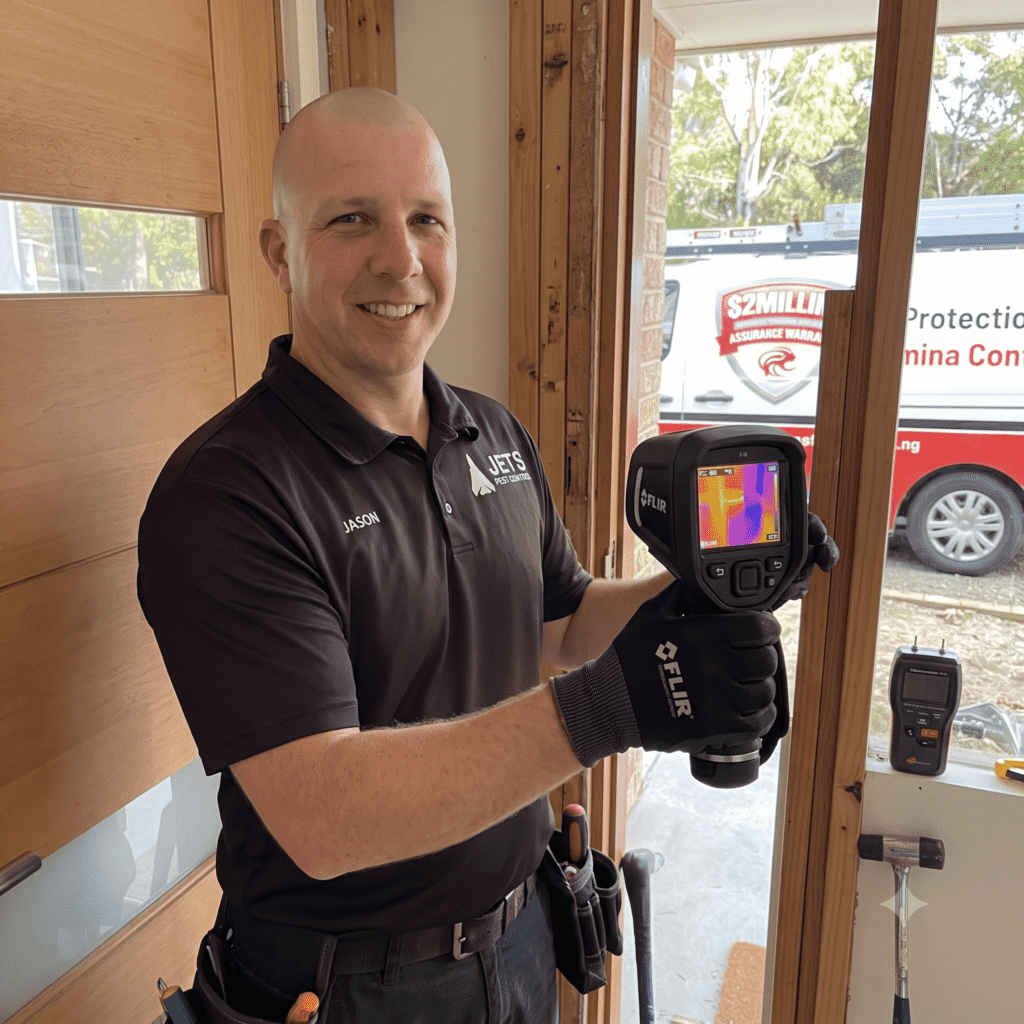
FLIR camera detects heat signatures and moisture anomalies inside walls without destructive access. Termatrac radar confirms active termite movement. Together, they identify active colonies inside sealed wall cavities that a visual inspection cannot reach. Used in targeted areas where visual findings raise concern.
Step by step: what actually happens during an inspection
Pre-inspection consultation
The inspector asks about any previous termite activity, recent renovations, areas of concern, moisture problems, or prior treatments. This informs which areas of the property receive the most thorough examination and where thermal imaging is most likely to be deployed.
External perimeter inspection
The inspector walks the full perimeter of the building, examining the external wall cladding, weep holes, garden beds adjacent to the foundation, tree stumps, timber retaining walls, fences with soil-to-timber contact, and any outbuildings. This phase identifies conducive conditions and potential colony entry points.
Subfloor inspection
Where the property has an accessible subfloor space — common in Queenslander and elevated homes across Ipswich and Brisbane — the inspector physically enters the subfloor to examine the underside of floor joists, bearers, stumps, and brick piers. This is where mud tubes connecting underground galleries to the structure are most often first detected. A torch, probe, and moisture meter are used throughout.
Internal room inspection
Each room is inspected systematically. The inspector taps skirting boards, door frames, window sills, and floor surfaces with a sounding tool. All timber is assessed for the hollow, papery sound that indicates internal excavation. Moisture readings are taken in areas of concern — bathrooms, laundries, and areas adjacent to plumbing penetrations where moisture provides a conducive environment for termites.
Roof void inspection
The inspector accesses the roof void through the manhole and visually examines roof trusses, wall plate timbers, and any stored timber or cardboard. Roof void infestations are common in properties where subfloor chemical barriers are in place — colonies that cannot enter from below seek alternative routes and may gain access through the roof. A torch and probe are used to check accessible trusses.
Thermal imaging — targeted wall scanning
Where any of the above phases raises concern — a slightly hollow sound, an unexplained moisture reading, a subtle colour change in paint — the FLIR thermal camera is deployed on the relevant wall surfaces. The camera produces a colour-coded thermal map showing temperature differences across the surface. Active termite galleries register as warm anomalies surrounded by cooler, dry timber. Moisture from termite activity registers as a cooler, denser signature. The inspector interprets these patterns in context.
Termatrac radar confirmation
Where thermal imaging identifies a suspected active area, the Termatrac T3i is held against the wall surface at the same location. The device emits microwave radar and measures the frequency shift caused by insect movement within. A positive radar reading in conjunction with a thermal anomaly provides high-confidence confirmation of active termite presence without a single hole being drilled.
Written inspection report
A detailed written report is provided following the inspection. In accordance with AS 3660.2, this documents all areas inspected, all findings including conducive conditions, any evidence of termite activity, the tools and methods used, and recommendations for treatment, further investigation, or preventative measures. The report is a formal document suitable for property purchase due diligence, insurance records, or mortgage requirements.
What thermal imaging can and cannot detect
Thermal imaging is a powerful tool, but it is not infallible. A licensed inspector needs to understand its limitations in order to use it responsibly.
What thermal imaging detects
- Heat generated by active termite colonies inside wall cavities
- Moisture anomalies consistent with termite gallery systems
- Plumbing leaks and moisture ingress from external sources (useful diagnostic tool in its own right)
- Thermal bridging from structural voids or insulation gaps
What thermal imaging does not detect
- Small or inactive colonies that generate insufficient thermal contrast
- Colonies in walls that are already at thermal equilibrium with the surrounding environment
- Historical termite damage where the colony has been treated and departed
- Activity in areas with heavy insulation, double-brick construction, or significant external thermal load
This is why Termatrac radar is used in conjunction with thermal imaging — radar detects movement directly, regardless of thermal conditions. Together, they provide a diagnostic capability that far exceeds what is possible with a purely visual inspection.
All Jets Pest Control timber pest inspections are conducted by licensed timber pest inspectors in accordance with Australian Standard AS 3660.2. Jason Forman (Senior Technician and Timber Pest Inspector) and Shaun Michels bring over 35 years of combined industry experience. FLIR thermal imaging and Termatrac T3i radar are deployed on all targeted investigations where visual evidence warrants further investigation.
How often should you have a thermal termite inspection?
Australian Standard AS 3660.2 recommends annual timber pest inspections for all properties in high-risk areas — which encompasses the entirety of South East Queensland. The recommendation is for a full AS 3660.2 visual inspection every 12 months. Thermal imaging and radar investigation are typically deployed on a needs basis during these annual inspections, or as a standalone targeted investigation when a homeowner has specific concerns about a particular area of the property.
Properties in the highest-risk zones — those within 50 metres of mature eucalyptus or Lilly Pilly trees, with elevated subfloors, or in low-lying areas with clay-rich soil — may benefit from six-monthly inspections during summer months when colony activity is at its peak.
Visual timber pest inspection — Ipswich & Brisbane
Book a thermal termite inspection in Ipswich
FLIR imaging and Termatrac radar. See what a standard visual inspection misses. Written AS 3660.2 report included.
Book NowFrequently asked questions
What is a thermal imaging termite inspection?
What is a Termatrac inspection?
How much does a termite inspection cost in Ipswich?
How long does a termite inspection take?
Do I need to leave my house during a termite inspection?
Is thermal imaging included in a standard termite inspection?
Ready to protect your home?
Serving Ipswich and South East Queensland — fixed prices, no hidden extras, 10% off for Seniors, Pensioners, and ADF members.
Call 1300 566 569
