
Spider Control · South East Queensland
How to Spider-Proof Your Car and Garage in South East Queensland
A spider dropping onto a driver in a moving vehicle is a recognised road safety hazard. Huntsman spiders hiding behind sun visors and in door cavities are a common cause of near-miss incidents on Queensland roads. Regular inspection and a residual spider treatment reduce this risk significantly.
Why cars and garages attract spiders in South East Queensland
South East Queensland's warm, humid climate means spider populations are active year-round. Garages and vehicles are disproportionately attractive to spiders for three main reasons: shelter from weather and predators, warmth (especially in cars and heated garages), and proximity to insects that spiders feed on.
Garages are essentially climate-controlled caves from a spider's perspective. A typical double garage provides dozens of ideal harbourage points: cardboard boxes stacked in corners, tool racks with gaps, pipe penetrations through walls, the gap under roller doors, and the dark interior of stored items. Redback spiders in particular thrive in these conditions and will establish webs and lay egg sacs in areas that go undisturbed for weeks.
Cars present different but equally attractive conditions. Door mirror housings, the recess around the petrol cap, the gap between the bonnet and windscreen, and the interior — especially behind sun visors and under seats — all offer the dark, enclosed space spiders seek. Huntsman spiders are the most common species found inside car cabins, but Redbacks have also been found in wheel arches and underneath vehicles parked near garden beds.
The spiders most likely to be in your car or garage
Knowing which spiders you are likely to encounter helps you understand the level of risk and the appropriate response.
Female Redbacks are responsible for the majority of serious spider bites in Australia. They build messy, sticky webs in dry, sheltered spots — door mirror housings, under garden furniture stored in garages, and inside electrical boxes are all common locations. Bites cause intense, escalating pain and require medical attention.
While more commonly associated with Sydney, funnel-web spiders are found in parts of South East Queensland including the hinterland areas near Ipswich. Males wander in summer and can enter garages. A funnel-web bite is a medical emergency requiring antivenom. Do not attempt to handle if found.
Not dangerously venomous but extremely common inside car cabins, They enter through slightly open windows or gaps in door seals and hide behind sun visors, under seats, and in the boot. The primary risk is a sudden appearance while driving, causing the driver to lose control of the vehicle.
White-tailed spiders do not build webs — they wander and hunt at night, often hiding in clothing and shoes left on garage floors. Their bites can cause local pain and swelling, and occasionally more serious reactions. Common in garages with stored clothing or gym equipment.
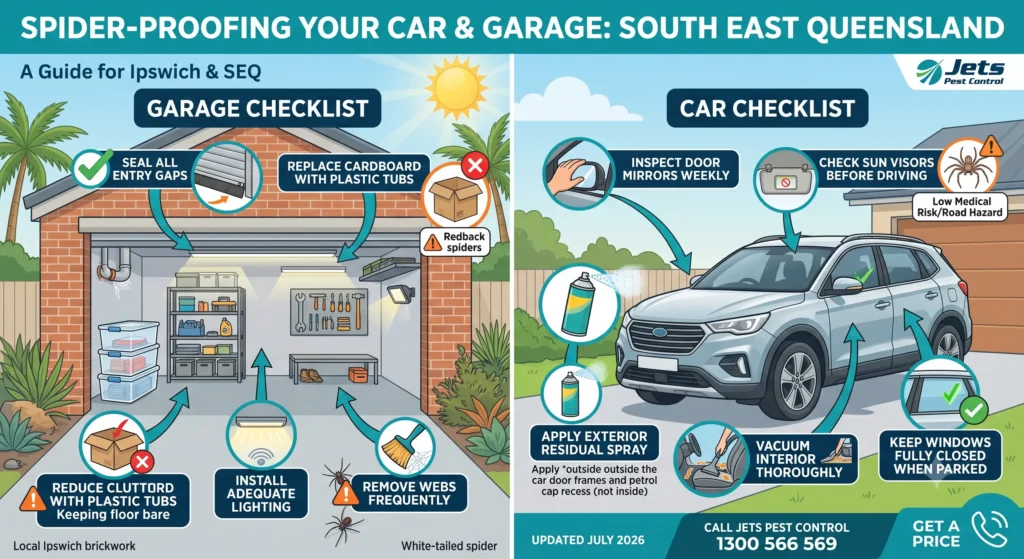
How to spider-proof your car
A car is a challenging environment to treat because you cannot use residual insecticides inside the cabin on surfaces you regularly touch. Spider-proofing a car therefore relies more heavily on prevention, inspection, and physical exclusion than chemical treatment.
-
Park away from vegetation and garden beds
The single biggest change you can make is where you park. Spiders enter cars most readily when the vehicle is parked next to garden beds, under trees, or against fences with vegetation. Parking in an open, cleared area — ideally in a garage — dramatically reduces the number of spiders that can access the vehicle.
-
Inspect door mirrors, petrol cap recesses, and wheel arches weekly
These exterior crevices are the most common Redback harbourage points on a vehicle. Check each door mirror housing, the recess around the petrol cap, and under the wheel arch lips at least once a week if you park outdoors. Use a torch and look for webs or egg sacs — small, papery, dome-shaped structures about the size of a marble. Remove webs immediately with a stick or long tool, not bare hands.
-
Vacuum the interior thoroughly and remove all food debris
Food crumbs and debris attract the insects that spiders feed on. A clean car interior is less attractive to spiders at every level of the food chain. Vacuum under seats, in boot corners, and along door sills regularly. Pay particular attention to the gap between the seat and centre console — a favourite hiding spot for wandering spiders.
-
Check sun visors and overhead lining before driving
Make it a habit to flip down sun visors and check them before you start driving, especially if the car has been parked outdoors or in a garage overnight. Huntsman spiders most commonly startle drivers by appearing on the windscreen side of the visor when it is lowered. A quick check takes seconds and prevents a dangerous in-traffic encounter.
-
Apply residual spider spray around door frames and exterior entry points
A pyrethroid-based residual spray applied around door seals, the petrol cap area, and wheel arches creates a chemical barrier that kills spiders on contact. Products available from automotive stores or hardware shops are suitable for exterior surfaces. Reapply after rain. Do not spray inside the passenger cabin on surfaces you contact — use a professional for interior treatments if required.
-
Keep windows fully closed when parked
Even a 2–3 cm gap in a window is sufficient for a Huntsman spider to enter. Always close windows fully when leaving the vehicle, even in hot weather. If you need ventilation, use a purpose-made mesh window vent rather than leaving the glass open.
Do not try to deal with a spider while the vehicle is moving. Signal, pull over safely, and stop the engine before attempting to remove the spider. If the spider is Huntsman-sized and you cannot locate it, exit the vehicle safely and contact a pest professional or wait until it emerges on its own. Never attempt to crush or swat a spider while driving.
How to spider-proof your garage
Garages are more straightforward to treat than cars because a broader range of exclusion methods and chemical treatments can be applied. A combination of structural exclusion, decluttering, and residual chemical treatment is the most effective approach.
Step 1 — Seal every entry point
Spiders enter garages through gaps around pipe penetrations, under roller doors, through damaged weatherstripping around personnel doors, and through gaps in eaves and soffit vents. Systematically inspect and seal all these entry points. Use door sweeps on the roller door, expanding foam or silicon sealant around pipe penetrations, and replace damaged weatherstripping on all doors and windows. This is the most permanent component of any spider-proofing programme.
Step 2 — Eliminate all cardboard boxes
Cardboard boxes are the single most common spider harbourage in Australian garages. The corrugated flutes inside cardboard provide hundreds of small, dark hiding spaces that spiders — especially Redbacks — find ideal. Replace all cardboard storage with sealed plastic tubs with clip-on lids. This removes the most attractive harbourage option in one step.
Step 3 — Reduce clutter and elevate stored items
The more clutter in a garage, the more hiding spots available. Reduce stored items to the minimum, keep items on shelving rather than on the floor, and ensure there is clear space around the perimeter of the garage. Items stored directly on the floor — particularly in corners — are the most likely to harbour White-tailed spiders and Redbacks.
Step 4 — Install adequate lighting
Spiders prefer dark environments. A well-lit garage is less attractive to them. Install LED strip lighting along the tops of storage shelving and in the corners of the garage. Motion-activated lighting at entry points also discourages spiders from establishing webs near the door thresholds.
Step 5 — Apply a professional residual perimeter spray
A professional-grade insecticide spray applied around the interior perimeter skirting, wall-ceiling junctions, and all shelving is the chemical component of a comprehensive spider treatment. The active ingredients most effective against spiders are pyrethroids such as Bifenthrin and Deltamethrin, which remain active for six to twelve weeks on porous surfaces. Over-the-counter consumer sprays are significantly less concentrated and require more frequent reapplication.
For the exterior of the garage, a residual spray should be applied around the roller door frame, eaves, and any weep holes or ventilation gaps. This creates an outer barrier that kills spiders before they find an entry point.
Step 6 — Remove webs immediately and consistently
Active web removal disrupts spider reproduction and forces relocation. Use a long-handled cobweb brush or vacuum with a crevice attachment to remove webs from all corners, wall-ceiling junctions, and behind stored items. Removing a web with an egg sac before it hatches prevents hundreds of spiderlings establishing in your garage. Make web removal a fortnightly habit.
For South East Queensland homes, an annual professional spider treatment of the garage and surrounding perimeter is recommended. Homes near bushland, creek lines, or with large garden areas may benefit from a six-monthly treatment schedule. Jets Pest Control applies a commercial-grade residual spray with a six to twelve month effective period on most interior surfaces, substantially longer than consumer products available in hardware stores.
The garage-to-car pipeline
A garage that is heavily infested with spiders creates a continuous supply of spiders that will find their way into any vehicle parked inside it. Treating the car and the garage separately gives incomplete results — both need to be addressed as part of the same programme.
If you park in a garage that has not been professionally treated, Redbacks and Huntsmans will routinely move from the garage environment onto and into the vehicle during the night. This is especially common in summer when spiders are most active. A thorough garage treatment followed by consistent maintenance is the most reliable way to keep both spaces spider-free.
When to call a professional
DIY spider management is effective for ongoing maintenance once a baseline has been established. However, a professional treatment is the right starting point for any of the following situations:
- You have found a Redback spider web with egg sacs in your garage or on your vehicle — a single egg sac can contain up to 250 eggs
- Vou have found what may be a Funnel-web spider in your garage — do not attempt to remove it yourself
- Spider activity has increased significantly despite regular web removal and DIY sprays
- You have young children or elderly residents who are at higher risk from spider bites
- Your property backs onto bushland or a creek line, which sustains higher spider populations year-round
Jets Pest Control provides comprehensive spider treatments covering garages, carports, and the full property perimeter. We use commercial-grade residual products and include web removal, egg sac treatment, and targeted application to all known harbourage points. Servicing Ipswich, Springfield, Redbank Plains, Ripley, Goodna, Collingwood Park, and surrounding suburbs. Call 1300 566 569 to book.
Frequently asked questions
What spiders are commonly found in cars and garages in Queensland?
How do I keep spiders out of my car in Queensland?
Can a spider bite me while I am driving?
How do I permanently spider-proof my garage?
Are Huntsman spiders in my car dangerous?
Book a spider treatment for your home or garage
Jets Pest Control provides professional residual spider treatments covering garages, carports, and full property perimeters across Ipswich and South East Queensland.

