
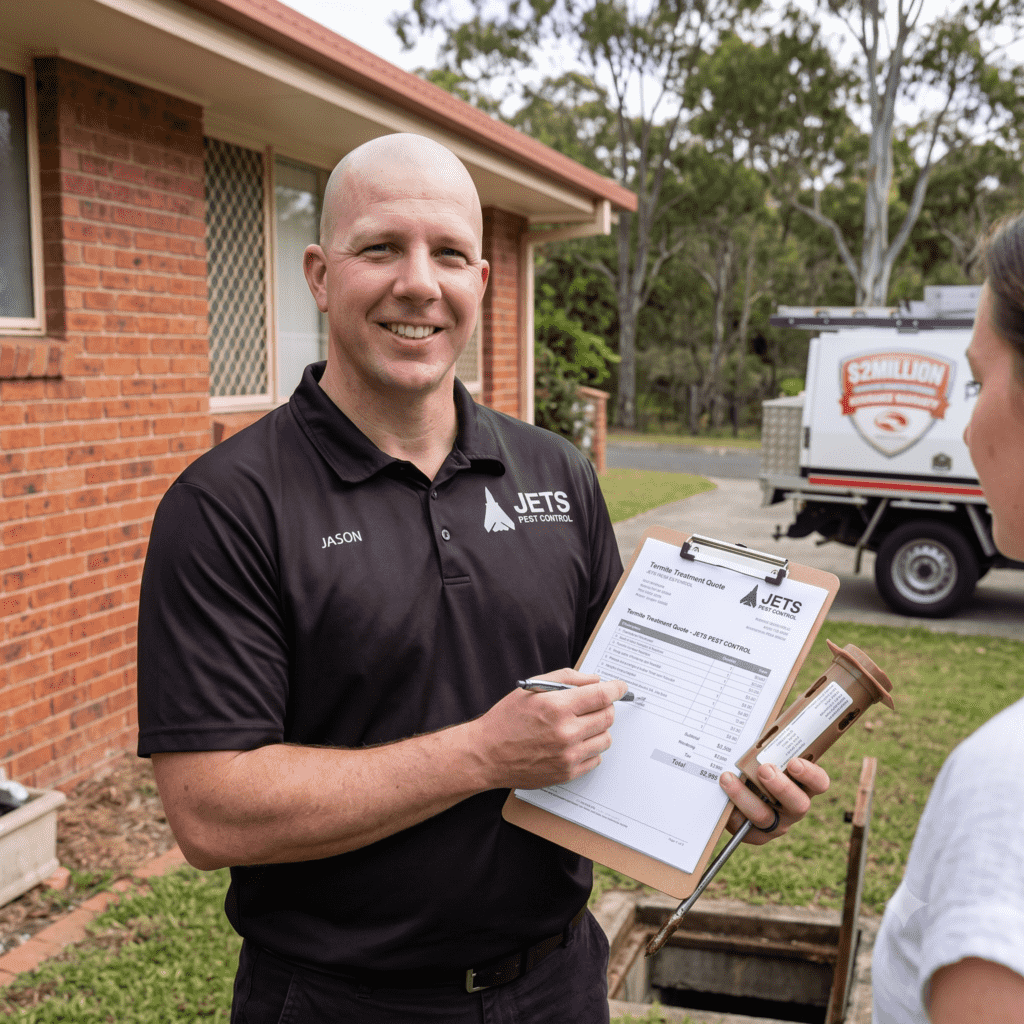
What does termite treatment actually cost?
Brisbane · Ipswich · QBCC licensed · AS 3660.1 & AS 3660.2
Inspections, eradication, chemical barriers, baiting systems — real prices for every stage of termite management in Brisbane and Ipswich, from a QBCC-licensed local specialist. No vague ranges, no hidden extras.
All prices at a glance
What does each type of termite service cost?
Termite management isn't a single service with a single price — it's a sequence of steps that depends on what's found at your property. Here are current Jets Pest Control prices for every stage, all including GST.
| Service | Price (incl. GST) |
|---|---|
| AS 3660.2 Termite Inspection Apartment | $185 |
| AS 3660.2 Termite Inspection Townhouse | $235 |
| AS 3660.2 Termite Inspection 1–4 bedroom house | $285 |
| AS 3660.2 Termite Inspection 5 bedroom house | $335 |
| AS 3660.2 Termite Inspection 6 bedroom or larger | $385 |
| Timber Pest Inspection AS 4349.3 Pre-purchase, apartment | $285 |
| Timber Pest Inspection AS 4349.3 Pre-purchase, 1–4 bedroom house | $385 |
| Timber Pest Inspection AS 4349.3 Pre-purchase, 5 bedroom house | $435 |
| Timber Pest Inspection AS 4349.3 Pre-purchase, 6 bedroom or larger | $485 |
| Termite Eradication Termathor dust or Termidor foam (per treatment point) | From $760 |
| Termidor HE Chemical Barrier Townhouse / unit | From $3,300 |
| Termidor HE Chemical Barrier Standard house | From $3,960 |
| Termidor HE Chemical Barrier Large home or complex layout | $4,620–$6,600 |
| Sentricon Always Active Baiting System Installation + first-year monitoring | From $2,200 |
| Sentricon Annual Monitoring Ongoing after first year | From $660 |
All prices include GST. A 10% discount applies for Seniors, Pensioners and ADF members on residential services at their principal place of residence. Prices are for Ipswich and Brisbane western suburbs. Rural and remote properties may incur a travel fee — ask when booking.
What does a termite inspection cost — and what does it cover?
A termite inspection to Australian Standard AS 3660.2 is the foundation of any termite management program. It's not a quote visit — it's a structured inspection of your entire property, performed by a licensed technician and documented in a written report that meets the Standard's requirements.
At Jets Pest Control, inspections use FLIR thermal imaging to detect temperature differences behind wall linings, Termatrac radar to locate termite movement without invasive drilling, and Tramex moisture meters to identify timber moisture that indicates either active termites or the conditions that attract them. The written report documents all findings, any conducive conditions on the property, and the basis for any treatment recommendation.
For pre-purchase timber pest inspections to AS 4349.3 — the broader report required when buying a property, covering borers and fungal decay as well as termites — prices range from $285 for an apartment to $485 for a larger home.
Australian Standard AS 3660.2 recommends inspections at intervals not exceeding 12 months — and every 3 to 6 months in high-risk areas. Southeast Queensland, including Ipswich and Brisbane, is classified high-risk. If it's been more than 12 months since your last inspection, that's the first cost to consider. See do I really need annual termite inspections? for the full picture.
What does termite eradication cost?
If your inspection finds an active colony, eradication is the first treatment step. The goal is to eliminate the colony before a long-term barrier is installed. Two methods are used depending on where the colony is located and how accessible the workings are.
Termathor dust (bifenthrin)
A fine dust applied directly into active termite workings using a bellows applicator. Foraging termites carry the dust back to the colony and spread it through grooming, killing the colony from within. Most effective where workings are accessible — subfloor timbers, wall voids, external landscape timbers.
Termidor foam (fipronil)
Expanding foam injected into wall cavities and inaccessible voids where dust can't reach. Termites contact the treated foam and spread fipronil through the colony via social behaviour. Often used in conjunction with dusting where workings extend through wall linings.
Eradication is priced from $760 and depends on the size of the infestation, the number of treatment points required, and the accessibility of the affected timbers. A very large, dispersed colony with workings in multiple wall cavities will cost more than a localised infestation in an accessible subfloor.
Eradication alone is not a complete termite solution. It eliminates the current colony but leaves the property unprotected from future attack. In almost all cases, eradication is followed by installation of a chemical barrier or baiting system as a long-term management strategy.
What does a Termidor HE chemical barrier cost?
A chemical barrier is the most common long-term termite management solution for existing homes in Southeast Queensland. Termidor HE (fipronil) is applied to the soil around and beneath the structure — trenched and treated along the full building perimeter, injected through concrete paths and patios where required, and reticulated under the slab if a reticulation system is present.
Termidor HE works via a 'Transfer Effect' — termites that contact the treated zone carry fipronil back to the colony and transfer it through grooming and feeding, eventually eliminating the colony rather than just repelling it. It does not create a repellent barrier that termites can detect and route around.
The main factors that affect barrier cost are the linear metres of perimeter treated, the amount of concrete that requires injection drilling, and whether a reticulation system is already in place. A simple single-storey slab-on-ground home on a standard 600 square metre block is at the lower end of this range. A larger two-storey home with extensive concrete surrounds, a pool, and difficult access points sits at the higher end.
Jets Pest Control is a BASF-certified Termidor Assurance Warranty applicator. The warranty covers structural damage caused by termite attack up to $2 Million for up to 8 years, subject to annual inspections by a licensed applicator. The warranty is renewed each year following the inspection. It is one of the strongest manufacturer-backed warranties available for termite management in Australia.
What does a baiting system cost?
Baiting systems are an alternative to chemical barriers and the preferred approach where a chemical application isn't suitable — for example, near water sources, where soil conditions limit chemical penetration, or where the homeowner prefers to avoid soil-applied chemicals.
Sentricon Always Active is the system Jets Pest Control installs. Stations are placed in the ground around the perimeter of the structure at regular intervals. Each station contains Recruit HD bait matrix, which termites feed on and carry back to the colony. Unlike monitoring-only baiting systems, Sentricon Always Active contains bait from day one — there is no waiting for termites to be detected before bait is deployed.
Baiting systems have a lower upfront cost than chemical barriers, but require ongoing annual monitoring fees to remain effective. Over a 10-year period, the total cost of a baiting system is typically comparable to or greater than a chemical barrier with annual inspections. The right choice depends on your property, your situation, and the recommendation from your licensed inspector.
What factors affect the total cost of termite treatment?
Two properties of similar size can have significantly different treatment costs. The main variables are:
- Property size and perimeter — chemical barriers are priced on linear metres treated. A larger perimeter means more product, more labour, and more time.
- Concrete and paving — any concrete slab, path, or patio that runs to the building edge requires injection drilling to treat the soil beneath. More concrete means more drill points and more time.
- Extent of the active infestation — a localised colony in an accessible subfloor is less costly to eradicate than one that has spread through wall cavities across multiple rooms.
- Access difficulties — very low subfloors, tightly planted gardens, or extensive decking built over the treatment zone all affect the time required to complete the work.
- Soil type — clay soils require higher application volumes to achieve the required treated zone depth than sandy or loam soils, which can affect product cost.
- Whether a reticulation system exists — if a reticulation system was installed during construction, barriers can often be refreshed at lower cost by pumping chemical through the existing network rather than trenching and drilling.
Termite treatment quotes cover the pest management work: inspection, eradication and the barrier or baiting system. They do not cover structural repairs to damaged framing, flooring, wall linings or roof timbers — that work is carried out by a builder or carpenter. The BASF Termidor Assurance Warranty covers future damage caused by termites after the barrier is installed. It does not cover the cost of repairing damage that already existed at the time of treatment.
What does it cost to do nothing?
Termite damage in Australia costs homeowners an estimated $1.5 billion per year, and home insurance does not cover it. The comparison that matters isn't "treatment cost vs. zero" — it's "treatment cost vs. the cost of discovery after significant feeding."
Annual inspections only (no active colony found)
$285 per year for a standard house. Over 10 years: $2,850. Any active colony is caught within 12 months of establishment.
Inspection + eradication + barrier (active colony found)
$285 inspection + $760 eradication + from $3,960 barrier = from $5,000 for a standard house. BASF warranty covers future attack for up to 8 years.
No inspections — colony found after extended feeding
Eradication and barrier from $5,000, plus structural repairs to framing, flooring or roof timbers that insurance won't cover. Total exposure: $15,000–$60,000+ depending on extent.
Frequently asked questions
Does home insurance cover termite damage in Australia?
No. Home and contents insurance in Australia almost universally excludes termite damage. Insurers classify it as a maintenance issue rather than a sudden or accidental loss, which means there is no policy to claim on. The full cost of structural repairs — framing, flooring, wall linings, roof timbers — is carried by the homeowner. This is one of the core reasons why regular inspections and long-term barrier systems are worth considering as a risk management cost rather than an optional extra.
Is a chemical barrier or a baiting system better value?
It depends on the property and situation. A chemical barrier has a higher upfront cost but no mandatory annual fee beyond the inspection required to maintain the warranty. A baiting system has a lower installation cost but requires ongoing annual monitoring fees. Over 10 years, the total cost of the two approaches is generally comparable. The right system depends on property layout, soil type, water proximity, and the recommendation of your licensed inspector based on what they find at your property.
How long does a termite barrier last?
Termidor HE is APVMA-registered for a minimum soil life of 8 years when applied at the label rate. The BASF Termidor Assurance Warranty runs for up to 8 years, renewed annually following each inspection by a certified applicator. After 8 years, a new inspection and barrier refresh is typically recommended. In practice, some barriers remain effective beyond this period, but the warranty coverage and the manufacturer's performance guarantee apply to the 8-year window.
Can I get a discount on termite treatment?
Jets Pest Control offers a 10% discount for Seniors, Pensioners and ADF members on all residential services at their principal place of residence. This applies to inspections, eradication and barrier installation. No voucher or code is required — simply mention it when booking. We do not offer same-day pressure discounts or expiring specials; our prices are the same whether you book today or next week.
Do I need to be home during treatment?
For a visual inspection, yes — a licensed technician needs access to the interior of the building, including all rooms, the roof void and the subfloor. For barrier installation, you generally need to be home at the start of the job to provide access and confirm the scope, but you don't need to be present for the full duration of the external work. Your technician will advise what access is needed when you book.
How do Jets Pest Control prices compare to other Ipswich pest controllers?
Our prices are consistent with the Queensland market for comparable licensed work — QBCC-licensed technicians, APVMA-registered products applied at label rates, work that meets AS 3660.1 and AS 3660.2, and written reports for all inspections. We're not the cheapest quote you'll find, and we're not trying to be. Quotes that are significantly below market usually reflect a shorter treatment zone, a lower product volume, or work that doesn't meet the Standard. If you're comparing quotes, we'd encourage you to ask every company to specify the product, the concentration, and the linear metres being treated before you decide.
Fixed prices. Written quotes. No pressure.
Know exactly what you're paying before we start.
Serving Ipswich and South East Queensland — fixed prices, no hidden extras, 10% off for Seniors, Pensioners, and ADF members.

