
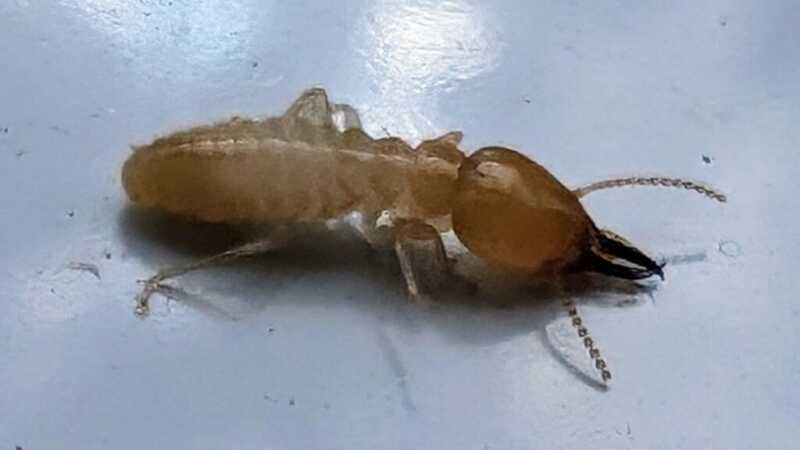
Termite Biology — Coptotermes acinaciformis
How fast can Coptotermes acinaciformis destroy a timber frame house?
The biology behind the destruction
Coptotermes acinaciformis is classified as a Class 1 structural timber pest in Australia — the highest risk category assigned by the Australian Standard for timber pest management. It is responsible for the vast majority of termite-related structural damage in South East Queensland, and its biology is specifically engineered for maximum concealment, rapid expansion, and efficient resource exploitation.
The colony structure consists of a single primary queen, a primary king, supplementary reproductives, soldiers, and vast numbers of workers — the caste responsible for all foraging and feeding. In a well-established colony, worker numbers range from several hundred thousand to over three million. Each worker continuously forages, consuming cellulose from timber and returning nutrient-rich material to feed the queen and developing larvae.
In South East Queensland's warm, humid climate, colonies are active year-round. There is no winter shutdown, no seasonal dormancy. The colony feeds 24 hours a day, 365 days a year. Understanding this biology is essential context for the annual termite inspections that the Australian Standard AS 3660.2 recommends for all high-risk zones — including the entirety of SEQ.
How quickly does the damage actually progress?
The rate of timber destruction is a function of three variables: colony size, the moisture content of the targeted timber, and ambient temperature. All three are highly favourable to rapid destruction in SEQ.
Establishment and gallery formation
Workers locate the structure and begin excavating entry galleries through soil-to-timber contact, weep holes, expansion joints, or penetrations. They establish foraging trails through the subfloor space or wall cavity, consuming the softest, most accessible timber first — typically sapwood in floor joists or base plates. No external signs are visible.
Active structural consumption
The colony scales its activity to match the food source. A mature colony consuming 500 grams per day can hollow out a standard 90mm × 45mm wall stud in approximately four to six weeks of focused attack. Over a 6-to-12-month period, multiple studs across a single wall frame are compromised. The outer surface remains intact — a paper-thin veneer of paint or plaster concealing complete internal destruction. Still no homeowner-visible signs in most cases.
First visible signs emerge
As structural members lose section integrity, they begin to deflect under load. Doors and windows start to jam. Paint begins to blister from elevated moisture inside the wall cavity. In severe cases, floor surfaces become slightly springy or uneven. Mud tubes may become visible in the subfloor space or on external surfaces. Most homeowners at this stage still do not connect these signs to termites.
Structural failure risk
Without detection and treatment, a large colony will continue spreading laterally through the wall frame, upward into roof trusses, and downward into subfloor bearers. Load-bearing capacity is compromised across multiple structural elements simultaneously. At this stage, repair costs routinely exceed $30,000 to $100,000. In extreme cases — particularly with older homes on timber stumps — complete structural failure of a subfloor, wall, or roof section becomes a genuine risk. If termites are found, professional termite treatment must begin immediately.
Why Queensland homes are particularly vulnerable
The combination of biological and environmental factors in SEQ creates near-ideal conditions for Coptotermes acinaciformis colonies to thrive and cause damage at an accelerated rate relative to most other parts of Australia.
Climate — warm and humid year-round
Coptotermes acinaciformis requires a sustained temperature above approximately 20°C and high ambient moisture to maintain maximum colony activity. South East Queensland delivers both, year-round. In Melbourne or Sydney, colonies experience a partial slowdown in winter. In Brisbane and Ipswich, there is no such seasonal reduction. Damage accumulates continuously across all 12 months.
Soil type — clay-rich and moisture-retaining
The expansive clay soils common across Ipswich, the Lockyer Valley, and significant parts of Brisbane retain moisture exceptionally well. This provides the colony with a reliably humid environment for its underground gallery system, making the physical effort of reaching above-ground timber significantly lower and more sustainable over long periods.
Housing stock — mature timber-framed construction
A significant proportion of Ipswich and Brisbane's residential housing stock consists of Queenslander and post-war timber-framed homes with elevated subfloors. The subfloor void creates a protected, humid, and highly accessible environment for termites to establish foraging galleries adjacent to the primary structural timbers without any exposure to weather, predators, or human observation.
A $185 annual inspection that detects a colony in month six of its activity saves tens of thousands of dollars in structural repairs. The same colony detected in year three may require repairs costing more than the inspection fee multiplied by 50. There is no insurance. There is no alternative. Detection is the only protection.
How the colony remains hidden for so long
Coptotermes acinaciformis has evolved several specific biological mechanisms that contribute to its extraordinary concealment inside built structures.
Inside-out consumption
Workers consume timber from the inside out, always maintaining a thin outer layer of intact material. They are photophobic — deeply averse to light — and will not break through to an exposed surface unless structurally forced to. The outer layer of paint or plaster therefore remains visually intact across a completely hollow structural member.
Mud sealing
Every gallery entry, junction, and vulnerable point in the foraging system is sealed with a material called carton — a mixture of soil particles, saliva, and faecal matter. Carton is highly effective at retaining moisture and excluding light. It is also strong enough to support the weight of the overlying plaster or paint, meaning sealed entry points are effectively invisible to the naked eye.
Fontanelle secretion — the alarm response
When the colony is disturbed — by tapping, by opening a mud tube, or by the application of an aerosol insecticide — soldier termites release a white, sticky secretion from the fontanelle pore on their heads. This acts as both a chemical alarm signal to the rest of the colony and a physical barrier to the intrusion. Within minutes of disturbance, workers begin sealing galleries and the colony retreats to deeper, safer sections of the wall system.
This is the biological reason why disturbing suspected termite activity is counterproductive. The colony's alarm response is fast, effective, and leaves the professional inspector with a significantly harder job.
Jets Pest Control's licensed timber pest inspectors bring over 35 years of combined experience in timber pest identification and management across South East Queensland. All inspections are conducted in accordance with Australian Standard AS 3660.2, with FLIR thermal imaging and Termatrac radar technology available for targeted investigations where visual evidence is inconclusive. Book a termite inspection — we serve Ipswich, Brisbane, and surrounding SEQ suburbs.
What an annual inspection actually protects against
A professional annual timber pest inspection provides the earliest possible detection window for Coptotermes acinaciformis activity. It does not guarantee that termites are absent — no inspection can make that claim for concealed wall cavities — but it provides the best available evidence of current conditions and gives the homeowner the information they need to act before damage becomes catastrophic.
In practical terms, detecting a colony in the first six months of its activity in your structure — which is achievable with annual inspections using thermal imaging — limits the structural damage to a fraction of what accumulates over two to five years of undetected foraging. That difference, in repair cost terms, is routinely between $2,000 and $100,000. For Brisbane properties, our termite control Brisbane service covers all SEQ suburbs.
If you are concerned about ongoing protection after an infestation is treated, a professionally installed chemical termite barrier around the perimeter of your home is the most reliable long-term protection available.
Annual inspections from $185 — Ipswich & Brisbane
Coptotermes acinaciformis is active year-round in SEQ. The colony does not wait. Your inspection should not either.
Book Your InspectionFrequently asked questions
How fast can termites destroy a house in Australia?
What does Coptotermes acinaciformis look like?
How far do Coptotermes acinaciformis termites travel from their nest?
Do termites eat through concrete?
What time of year are termites most active in Queensland?
Can I treat a Coptotermes acinaciformis infestation myself?
Ready to protect your home?
Serving Ipswich and South East Queensland — fixed prices, no hidden extras, 10% off for Seniors, Pensioners, and ADF members.
Call 1300 566 569
