
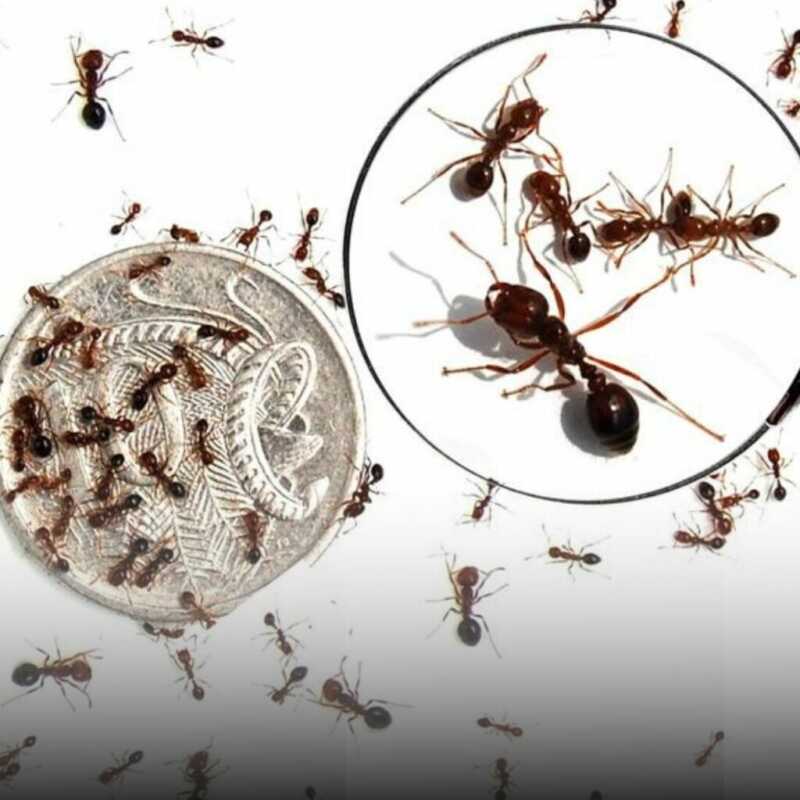
Fire ants in your yard: what to do, and what not to.
Southeast Queensland · Notifiable pest · DAFF program · Licensed treatment
Red imported fire ants are a notifiable pest in Queensland. If you find them, you are required by law to report them. Here's how to identify them, what reporting involves, and how licensed treatment works.
First: do not disturb the nest
What should you do if you find fire ants?
Stop. Do not kick, dig, water, or spray the mound. Disturbing a fire ant nest causes the colony to scatter immediately — workers swarm upward to defend, and the queen relocates deeper into the ground or to a satellite nest. Disturbing a mound before treatment makes eradication significantly harder.
The correct steps are: move away from the nest, mark its location (a garden stake or a photo with GPS coordinates works), and report it. In Queensland, red imported fire ants (Solenopsis invicta) are a notifiable pest under the Biosecurity Act 2014. If you suspect you have fire ants, you are legally required to report the sighting.
Report online at daf.qld.gov.au or call the Biosecurity Queensland hotline on 13 25 23. Report as soon as possible after identification — do not wait. Include the location, a description of the nest, and photos if you have them. Reports are followed up by the National Fire Ant Eradication Program.
How do you identify fire ants?
Correct identification matters because several ant species are commonly confused with fire ants — including the native green-headed ant and the tropical fire ant (Solenopsis geminata), which is already established in Queensland and is not subject to the eradication program. Reporting the wrong species wastes program resources; missing the right species lets the incursion spread.
Red imported fire ants (Solenopsis invicta) have a few distinctive characteristics:
- Colour — reddish-brown head and thorax, darker (almost black) abdomen. Not uniformly red, not uniformly black.
- Size variation within the colony — workers range from 2 mm to 6 mm in the same nest. Native ants within a colony are typically a uniform size.
- Nest shape — dome-shaped mounds of disturbed soil, typically 20 to 40 cm high and up to 60 cm across, with no visible entry hole on top. Entry points are at ground level around the base.
- Aggressive response — if the mound is accidentally disturbed, workers swarm rapidly and sting. This is the characteristic most commonly reported by homeowners who encounter them for the first time.
- Sting sensation — a burning, intense sting that develops into a white pustule within 24 hours. Native ant bites generally don't produce this reaction.
If you're not certain whether you've found fire ants, report the sighting regardless. The DAFF identification guide includes photos to help compare species. Biosecurity Queensland will assess the report and send an inspector if the description is consistent with fire ants. There is no penalty for a good-faith report of the wrong species.
Where are fire ants found in Brisbane and Ipswich?
Red imported fire ants were first detected in Brisbane in 2001, arriving via shipping containers at the Port of Brisbane. Since then, the incursion zone has expanded significantly across Southeast Queensland despite more than two decades of eradication effort. As of 2026, fire ant populations have been confirmed across a large area of Greater Brisbane, Ipswich, Logan, and surrounding shires.
Properties most likely to harbour nests include open, sunny areas: lawns, nature strips, sports fields, paddocks, garden beds, and disturbed soil along fence lines or construction sites. Fire ants avoid dense shade and prefer dry, well-drained ground. They are particularly active in warm weather and after rain, when new mounds appear as colonies expand.
The DAFF maintains a fire ant distribution map updated regularly with confirmed and suspected detection zones. If you're in Greater Ipswich or western or southern Brisbane, your property may be within or adjacent to a known incursion zone.
Why can't I treat fire ants myself?
The short answer: individual nest treatment rarely works, and it can actively spread the colony.
Fire ant colonies typically contain multiple queens and hundreds of thousands of workers. A large colony may have interconnected satellite nests across a wide area. Pouring boiling water, applying retail ant products, or digging up a mound might kill workers at the surface, but it almost never reaches the queens deep in the nest — and the disturbance causes the colony to split and relocate.
APVMA-registered products effective against fire ants require specific application methods — broadcast baiting across the property perimeter and surrounds, followed by individual mound treatment — that aren't practical for homeowners to carry out safely and effectively. Products available in hardware stores are generally not labelled or formulated for fire ant eradication.
The National Fire Ant Eradication Program coordinates treatment across known incursion zones, and DAFF-authorised treatments may be available at no cost to you depending on your location. Licensed pest controllers supplement this with treatment of individual properties, particularly where nests are found in areas the program hasn't yet reached or where ongoing monitoring is needed.
What does professional fire ant treatment involve?
Treatment follows a structured approach: inspection, broadcast baiting across the property, direct mound treatment, and a follow-up inspection to confirm colony collapse. The products used — and the expected timeframes — vary depending on the situation.
Inspection and mapping
A licensed technician walks the property to identify and map all visible nest locations and assess the extent of the infestation. Nests may not be immediately obvious — small mounds can be mistaken for disturbed soil, and satellite nests may be present some distance from the main colony.
Broadcast baiting
Fire ant bait is distributed across the treatment zone. Workers forage for it and carry it back to the colony, where it reaches the queens. Two registered products are used, with different active ingredients and timelines:
Distance Plus (active ingredient: pyriproxyfen 5 g/kg) is an insect growth regulator distributed by the National Fire Ant Eradication Program to many residents. Rather than killing ants directly, it mimics a juvenile insect hormone and prevents the colony from reproducing normally. Because of this mode of action, it is slow acting — visible and active nests may take 3 to 6 months to die out, with up to 3 applications per year at 12-week intervals (spring, summer and autumn) typically required. This timeframe is often not well communicated to residents receiving treatment kits from the program.
Advion Fire Ant Bait (active ingredient: indoxacarb 0.45 g/kg) is a faster-acting alternative. Colonies should start showing signs of decline within several days of treatment. Up to 4 applications per year can be made at 12 to 16-week intervals. For individual nests, approximately 15 g (about 4 level tablespoons) is applied per nest. If visible nests remain active 5 weeks after treatment, retreatment is required.
Direct mound injection
Under APVMA Permit PER14770, authorised operators can inject fire ant mounds directly with approved fipronil-based insecticides. This targets the colony directly rather than relying on foraging behaviour, and generally provides much faster knockdown than bait alone. Nest activity often declines significantly within days of treatment, with colony elimination typically occurring over the following weeks depending on colony size and treatment coverage. Direct injection is carried out by authorised operators in strict accordance with permit conditions.
Follow-up inspection
A follow-up visit confirms colony collapse and identifies any remaining or new activity. Fire ant management is not a one-visit job — monitoring for new mounds over subsequent weeks is part of a complete treatment, particularly when baiting products with longer timelines are used.
If your property has been treated with Distance Plus through the program, don't be concerned if mounds remain visible after several weeks — this product takes 3 to 6 months to fully collapse an established colony, and multiple treatments at 12-week intervals may be needed. If you need faster results, licensed treatment with Advion or fipronil injection can significantly shorten that timeline. Call Jets on 1300 566 569 to discuss your options.
Depending on your address, the National Fire Ant Eradication Program may be able to arrange treatment of your property at no cost. Report your sighting through the DAFF hotline first — they will advise whether your property falls within a funded treatment zone. Jets Pest Control provides supplementary and faster-response treatment for properties where it's needed.
What are the health risks of fire ants?
Fire ants are a genuine public health concern, not just a nuisance pest. Their sting delivers venom containing alkaloids that cause an intense burning sensation, followed by a raised white pustule that typically resolves within a week but can become infected if scratched.
For most people, a small number of stings causes local pain and temporary discomfort. The serious risk arises from two situations: mass stinging events, and anaphylaxis in sensitised individuals.
Mass stinging
Disturbing a nest, or standing on a hidden mound, can result in hundreds of stings within seconds. This is particularly dangerous for children, elderly people, or anyone who cannot move away quickly. Young children playing on lawns are at heightened risk.
Anaphylaxis
Around 1 to 2 per cent of people who are stung develop a severe allergic reaction. Anaphylaxis from fire ant stings has been fatal. People who experience systemic symptoms after a sting — hives, swelling beyond the sting site, difficulty breathing, dizziness — should seek emergency medical attention immediately and be assessed for venom allergy.
Agricultural and environmental impact
Beyond human health, fire ants threaten livestock, ground-nesting wildlife, and agricultural land. CSIRO modelling estimates that if fire ants become fully established across Australia, the economic impact could exceed $1.7 billion per year in agricultural losses, medical costs, and biodiversity damage.
Frequently asked questions
Are fire ants in Ipswich and Brisbane?
Yes. Red imported fire ants have been confirmed across a significant area of Southeast Queensland including parts of Greater Ipswich, Greater Brisbane, Logan and Scenic Rim. The incursion zone continues to be mapped and updated as new detections occur. If you find a suspicious mound in these areas, treat it as a potential fire ant nest until confirmed otherwise. Report to Biosecurity Queensland on 13 25 23.
What happens after I report a fire ant sighting?
Biosecurity Queensland will assess your report and, if it's consistent with fire ants, arrange an inspection by an authorised officer. If fire ants are confirmed, they will advise whether your property falls within a funded treatment zone and coordinate treatment accordingly. This process can take some days, so report promptly. Do not disturb the nest while waiting for an inspector.
Is there a fine for not reporting fire ants?
Under Queensland's Biosecurity Act 2014, landholders have a general biosecurity obligation. While penalties depend on the circumstances, failing to report a known notifiable pest can result in significant fines. More importantly, unreported nests allow the incursion to spread, undermining the national eradication effort. Report as soon as you suspect fire ants — it costs nothing and takes under five minutes online.
Can I use ant baits from a hardware store to treat fire ants?
No. Retail ant products are not registered or formulated for fire ant eradication. They may kill foraging workers at the surface without reaching the queens, and disturbance can cause the colony to split and relocate. The registered products used for fire ant treatment — Distance Plus (pyriproxyfen), Advion Fire Ant Bait (indoxacarb), and fipronil-based injectable products under APVMA Permit PER14770 — require correct application methods and, in the case of fipronil injection, can only be applied by authorised operators. Report the sighting and let licensed treatment proceed.
How long does fire ant treatment take to work?
It depends on the product used. Distance Plus (pyriproxyfen), which the National Fire Ant Eradication Program distributes to many residents, is an insect growth regulator that takes 3 to 6 months to eliminate an established colony, with multiple applications at 12-week intervals typically required. This timeframe is often not well communicated when residents receive treatment kits. Advion Fire Ant Bait (indoxacarb) is faster — colonies should start showing signs of decline within several days, with retreatment required if active nests remain after 5 weeks. Fipronil injection by an authorised operator is the fastest option, with nest activity often declining significantly within days of treatment.
How do I know if the ants in my yard are fire ants or something else?
Key identifiers: reddish-brown head and thorax with a darker abdomen, workers that vary in size from 2 mm to 6 mm within the same colony, dome-shaped mounds with no entry hole on top, and an aggressive swarming response if the nest is disturbed. The sting produces a burning sensation and a characteristic white pustule within 24 hours. If you're uncertain, photograph the ants and mound and report it anyway — Biosecurity Queensland will assess the report and can confirm identification.
Does Jets Pest Control treat fire ants?
Yes. Jets Pest Control provides licensed fire ant treatment in Ipswich and Brisbane for properties where supplementary treatment is needed beyond the national eradication program. This includes properties outside the current funded treatment zone, properties requiring faster response than the program timeline, and follow-up monitoring after initial treatment. Call 1300 566 569 or see our fire ant treatment page for current service details.
Found a suspicious mound?
Report first. Then call us.
Serving Ipswich and South East Queensland — fixed prices, no hidden extras, 10% off for Seniors, Pensioners, and ADF members.

