
Early warning signs of a bed bug infestation in your Brisbane home
Jets Pest Control — Brisbane & South East Queensland
Bed bugs are detected late in most infestations because the early signs are easily misread or dismissed. By the time bites become obvious, the colony has usually been established for weeks or months. This guide covers the physical evidence to look for before the infestation reaches a scale that makes treatment significantly harder.
Why bed bugs are difficult to detect early
Bed bugs (Cimex lectularius) are nocturnal and spend the majority of their time concealed in tight harbourage sites away from light. A single female introduced to a new environment can establish a colony over eight to twelve weeks before bites become frequent enough to prompt investigation. By that point, populations of several hundred individuals are typical. The early colony is small, the insects are the size of an apple seed or smaller, and they shelter in locations that are not routinely inspected.
Brisbane's warm climate accelerates bed bug development significantly. At temperatures above 23 °C — typical across much of South East Queensland for Six to eight months of the year — nymphs develop through their five instars faster and adults reproduce at higher rates than in cooler climates. This means an infestation that might take four months to become obvious in a temperate climate can become a significant problem in eight to ten weeks in Brisbane.
Physical evidence: what to look for and where
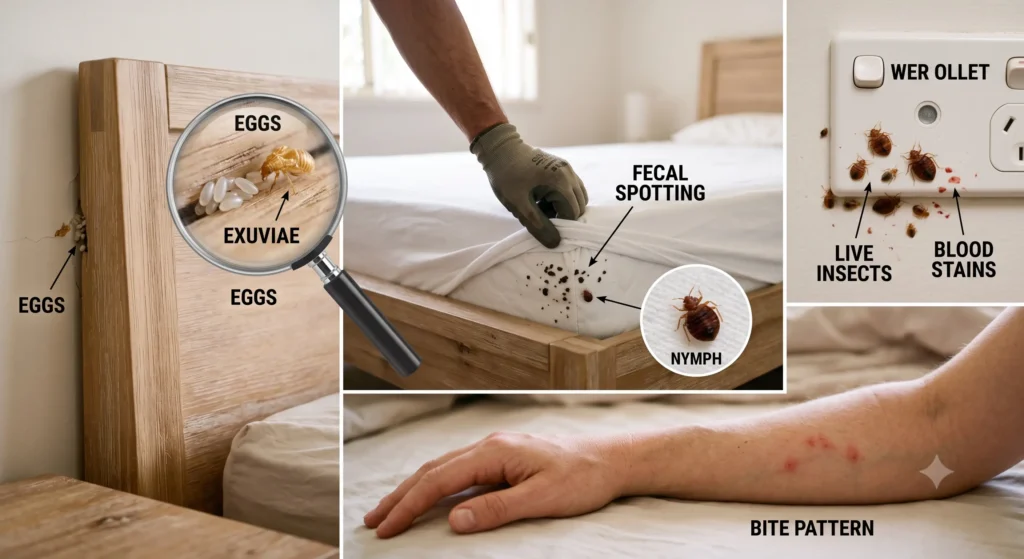
1. Dark faecal spotting on bedding and furniture
Bed bug excrement appears as dark brown to black spots, typically 1 mm or smaller, often with an irregular spread pattern where the liquid has wicked into fabric. These spots are digested blood and contain iron compounds that will not wash out of fabric easily. Common locations include mattress seams, the inside of fitted sheet elastic, the top edge of the mattress along the piping, and along the slats or frame of the bed base. On wooden or painted surfaces, spots appear as small flat marks. On fabric, they appear as tiny ink-blot-style stains.
Fresh spots are dark and wet-looking; older deposits dry to a dull brown-black. A single cluster of spots in a mattress seam at an early stage of infestation is often the first physical confirmation available. Use a bright torch and methodically inspect every seam and fold before concluding nothing is present.
2. Shed exoskeletons (cast skins)
Bed bug nymphs moult five times before reaching adulthood. Each moult leaves behind a translucent, hollow cast skin that retains the exact shape of the insect. These cast skins accumulate in harbourage sites and are one of the most reliable early indicators because they persist indefinitely and do not decompose quickly. They range from approximately 1.5 mm for first-instar skins to 4.5 mm for fifth-instar skins. They are pale amber to golden in colour when fresh and may darken slightly over time.
Cast skins are commonly found in mattress seams, along the wooden slat edges of bed bases, inside the box spring fabric, behind bedhead headboards attached to the wall, and in the joins of upholstered furniture. Finding even one cast skin confirms that at least one bed bug has successfully fed and developed in the environment.
3. Live insects at harbourage sites
Adult bed bugs are flat, oval, and reddish-brown, approximately 4 –5 mm in length. Unfed adults are very flat; recently fed adults are rounded and darker red. Nymphs are smaller and translucent to pale yellow when unfed. Inspecting harourage sites with a bright torch between midnight and 3 am, when bed bugs are most active, significantly increases the chance of observing live insects. During daylight hours, live insects are typically found by removing the mattress from the base and inspecting the concealed seams and underside, or by removing the slats from a timber bed base and inspecting the joins and any fabric stapled to the frame.
4. Blood smear marks on bedding
Small rust-coloured smear marks on sheets and pillowcases result from accidentally crushing a fed bed bug during sleep, or from the bed bug's bite site continuing to bleed briefly after the insect withdraws. These marks are distinct from faecal spotting — they are smeared rather than dotted, often appear as irregular rusty-brown streaks, and are located randomly across the sheet rather than concentrated at seams. Their presence confirms recent feeding activity, though they are easy to mistake for other marks and should be considered alongside other evidence rather than in isolation.
5. A sweet, musty odour
Established bed bug infestations produce a characteristic pheromone odour described as sweet and musty, sometimes compared to ripe raspberries or almonds. This odour is produced by aggregation pheromones and alarm pheromones released by the insects. It is generally only detectable at colony sizes of several hundred individuals and is therefore a later-stage indicator rather than an early warning. However, a noticeable sweet-musty odour in a bedroom without another obvious cause should prompt a thorough inspection.
Approximately 30 per cent of people do not react visibly to bed bug bites. Sharing a bedroom with someone who shows no bite reaction does not mean bed bugs are absent. Conversely, bite reactions that resemble bed bug bites are caused by a wide range of other insects and skin conditions. Physical evidence in the room is the only reliable early confirmation method.
Where to inspect in a Brisbane home
The bed itself
The primary harbourage zone for most infestations is the bed. Remove all bedding and inspect: mattress seams (all four sides, top and bottom), the mattress underside, the mattress label area, the piping around the mattress perimeter, and any handles or vents in the mattress side panels. Then remove the mattress from the base and inspect the base: slat edges and joins, any fabric stapled to the base, the corners and joins of the frame, and the castors or feet.
The bedhead and wall behind the bed
Bed bugs frequently establish secondary colonies behind bedheads, particularly those mounted to the wall or with hollow frames. Remove the bedhead if possible and inspect the bracket mounts, the wall surface behind the bedhead, and any gaps or joins in the bedhead material. Wall-mounted bedheads with hollow sections, fabric panels, or tufted upholstery are high-risk harbourage sites.
Nearby furniture and power points
As the colony grows, it expands to adjacent furniture — bedside tables, drawers, the inside of clock radios, and power outlets on the wall adjacent to the bed. Wall power points should be unscrewed and inspected behind the plate if other evidence is found. Bed bugs regularly shelter in the void behind power outlet covers, particularly those on walls shared with the bed.
Upholstered furniture
If bed bugs have been present for more than two to three months, secondary infestation of upholstered lounge furniture is common. Inspect seams, underneath cushions, the underside of the sofa base, and the joins between armrests and the main frame. In Brisbane rental properties with shared or second-hand furniture, upholstered lounge suites are a frequent introduction point.
Brisbane's high rental turnover rate and the prevalence of furnished short-term accommodation in inner suburbs create multiple introduction pathways. Bed bugs are commonly transported on luggage, second-hand mattresses, and upholstered furniture. Properties adjacent to holiday rental apartments or those with frequent tenant turnover have elevated introduction risk. If you have recently stayed in hotel or short-term accommodation and subsequently notice any of the early warning signs above, treat this as a strong indicator of a recent introduction.
The difference between early-stage and established infestations
Detecting bed bugs at the early stage — fewer than fifty individuals, contained to the primary harbourage site — makes treatment significantly more straightforward. A single targeted treatment of the bed zone using a combination of residual insecticide and contact dust is typically sufficient. At this stage, reinfestation risk from secondary harbourage sites is low.
At the established stage — several hundred individuals, spread to secondary furniture, wall voids, and adjacent rooms — treatment requires comprehensive inspection of all furniture, multiple targeted applications, and a follow-up visit to address any surviving eggs and recently hatched nymphs. The gap in cost and treatment complexity between early-stage and established infestations is significant.
Do
- Inspect mattress seams and bed base joins with a torch at the first sign of unexplained bites
- Check for cast skins and faecal spotting as the primary evidence — do not wait for bites to confirm
- Bag and wash all bedding at 60 °C or above immediately on suspicion
- Isolate the affected room where possible — do not move bedding or furniture to other rooms
- Book a professional inspection promptly — early-stage treatment is substantially less complex
- Inspect luggage after returning from travel, particularly overnight accommodation
Don't
- Assume the absence of bite reactions means the room is clear
- Use surface aerosol sprays — bed bugs in harbourage sites are not reached and may disperse further
- Move mattresses or furniture to other rooms without inspecting them first
- Discard the mattress without treating the base and frame — the infestation moves, not the colony
- Wait months for confirmation — a single cast skin is sufficient to warrant professional inspection
- Attempt heat treatment with domestic heaters — achieving the lethal temperature threshold (48 °C for 90 minutes) throughout furniture is not achievable with standard appliances
Frequently asked questions
What do bed bug bites look like, and how are they different from mosquito or midge bites?
Can bed bugs come from neighbours in an apartment building?
How long can bed bugs survive without a blood meal?
Do I need to throw away my mattress if I have bed bugs?
Can I treat bed bugs myself with products from the hardware store?
Suspect bed bugs? Book an inspection today.
Jets Pest Control provides targeted bed bug inspections and treatment across Brisbane and South East Queensland. Early detection means simpler, lower-cost treatment.

