
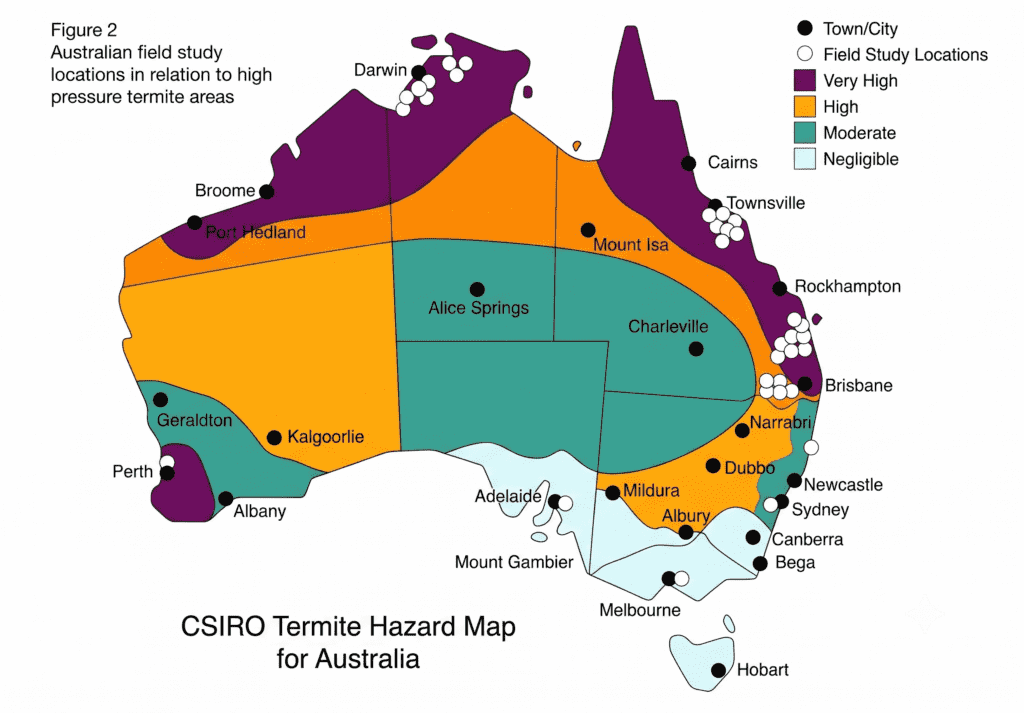
Termite Risk — CSIRO Data for SEQ
CSIRO termite risk map: is your Ipswich suburb in the danger zone?
The CSIRO and Australian Standard AS 3660.1 divide Australia into termite risk zones based on climate, soil type, and historical infestation data. South East Queensland — including the entirety of Ipswich, Brisbane, the Lockyer Valley, and the Somerset Region — is classified as High to Very High risk. This is the same classification that triggers mandatory termite management requirements under the National Construction Code for new buildings.
Which Ipswich and Brisbane suburbs carry the highest risk?
Termite risk within the SEQ region is not uniform. While the entire area is classified as high risk, several factors elevate specific suburbs and localities to very high risk:
- Proximity to large areas of native vegetation (bushland, parkland, golf courses with mature trees)
- Heavy clay or clay-loam soil types that retain moisture year-round
- Higher concentrations of older timber-framed housing stock (pre-1980 construction)
- Low-lying areas with seasonal flooding that elevates soil moisture consistently
| Area / Suburb | Risk Level | Key Factors |
|---|---|---|
| Ipswich city, Goodna, Redbank | Very High | Clay soils, high concentration of pre-1980 timber homes, proximity to riparian vegetation |
| Springfield, Ripley, Ipswich growth corridor | High | New development on previously vegetated clay soils, proximity to cleared bushland |
| Lockyer Valley (Gatton, Laidley, Plainland) | Very High | Deep clay agricultural soils, high moisture retention, abundant native tree vegetation |
| South Brisbane, Annerley, Moorooka | Very High | Pre-war and post-war timber housing, mature street trees and parkland vegetation |
| Kenmore, Fig Tree Pocket, Indooroopilly | Very High | Heavily vegetated river corridor suburbs, eucalyptus-rich canopy, older housing |
| Inala, Darra, Oxley | High | High proportion of elevated timber housing stock, clay-loam soils |
| Somerset Region (Toogoolawah, Kilcoy, Esk) | Very High | Rural properties adjacent to native bushland, timber construction, abundant eucalyptus |
Why clay soils dramatically increase your risk
The single most significant environmental factor for termite risk in residential properties — beyond climate — is soil type. Clay-rich soils dominate the Ipswich basin and large portions of south-west Brisbane. These soils retain moisture during dry periods, releasing it slowly and maintaining consistently elevated soil moisture content even during Queensland's dry season.
For Coptotermes acinaciformis, this moisture retention is critical. The colony requires a consistently humid underground environment to maintain its gallery system and support the queen's reproductive activity. Clay soils provide this stability far better than sandy or rocky soils, effectively extending the colony's foraging season from an intermittent activity in drier soils to a continuous, year-round operation in clay-dominant areas.
This means that a property on black clay soil in Ipswich presents significantly higher risk than a property on sandy loam at the same distance from native vegetation, because the soil supports a larger, more stable, and more continuously active underground colony population. See our termite inspection service for how we assess soil type and risk during a full AS 3660.2 inspection.
Does your block have these very high risk features?
- Any tree on the block or within 50 metres with a diameter greater than 300mm at chest height — potential colony nesting site
- A dead stump anywhere on the block or on neighbouring properties — the most common colony nest type in residential areas
- Garden beds with mulch or bark directly against the house wall — provides moisture and termite concealment at the structure's base
- Untreated timber retaining walls, decking posts, or fence palings with direct soil contact
- A property built before 1985 without documented termite treatment history
- A property that has had a chemical barrier installed more than 8 years ago without renewal
- A subfloor space with inadequate ventilation or water accumulation — persistent moisture is a primary attractant
Jets Pest Control's licensed timber pest inspectors — Jason Forman (Senior Technician and Timber Pest Inspector) and Shaun Michels — bring over 35 years of combined experience assessing termite risk across the Ipswich and Brisbane residential market. All inspections are conducted in accordance with Australian Standard AS 3660.2 with FLIR thermal imaging and Termatrac radar available for targeted investigations. Inspections from $185.
Why annual inspections are specifically required for high-risk zones
Australian Standard AS 3660.2 states that in high-risk areas, timber pest inspections should be conducted at intervals not exceeding 12 months. This is not a general recommendation — it is the documented standard for properties in the climate and soil conditions that characterise South East Queensland.
The practical reason for the 12-month interval is the rate at which Coptotermes acinaciformis colonies can establish themselves and cause significant structural damage. A colony that gains access to a structure in January can cause damage requiring $30,000 in repairs by December of the same year. An inspection in January that found no activity, and another inspection in January of the following year that finds severe structural damage, is technically compliant with the 12-month standard but leaves a full year of undetected destruction. This is the worst-case scenario the standard is designed to minimise — and it is achievable with consistent annual inspections even in the highest-risk zones.
Is your Ipswich suburb in the danger zone? Find out.
Annual timber pest inspections from $185 — FLIR thermal imaging and Termatrac radar. Written AS 3660.2 report. Know what's in your walls.
Book InspectionFrequently asked questions
Is Ipswich a high-risk area for termites?
What percentage of homes in SEQ get termites?
What soil types increase termite risk in Queensland?
Do new homes in Queensland need termite protection?
How close do you need to live to trees to have high termite risk?
Does a concrete slab protect a house from termites?
Ready to protect your home?
Serving Ipswich and South East Queensland — fixed prices, no hidden extras, 10% off for Seniors, Pensioners, and ADF members.
Call 1300 566 569
