
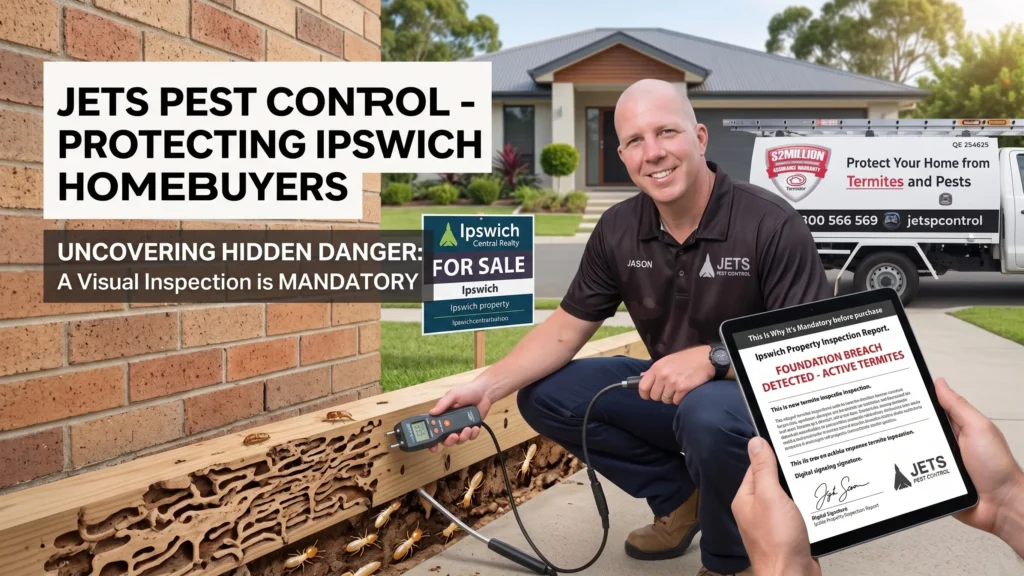
Why visual termite inspections are mandatory before buying an Ipswich home
Jets Pest Control | Ipswich & South East Queensland
In Queensland, a building and pest inspection is not legally required before purchasing a home — but failing to get one is one of the most expensive mistakes a buyer can make. Termites cause an estimated $1.5 billion in damage to Australian homes every year, and Ipswich sits in one of the highest-risk termite zones in the country.
Why Ipswich is a high-risk termite zone
Ipswich's climate, soil type, and housing stock combine to create near-ideal conditions for subterranean termites — the species responsible for the vast majority of structural timber damage in Queensland. The region's warm, humid summers accelerate colony growth, while the large number of older homes with timber stumps, timber framing, and mature vegetation provides abundant food sources close to the ground.
The predominant species in the Ipswich region include Coptotermes acinaciformis — Australia's most destructive termite — along with Schedorhinotermes intermedius and several Nasutitermes species. Coptotermes colonies can exceed one million workers and are capable of hollowing out structural timber while leaving an intact paint or plaster surface. Infestations of this species regularly go undetected for years because the external appearance of affected timber gives no indication of internal damage.
What a visual termite inspection actually covers
A visual termite inspection carried out by a licensed pest technician follows the Australian Standard AS 3660.2 and AS 4349.3. It involves a methodical examination of all accessible areas of the property, including:
- Sub-floor spaces and foundation timbers (if accessible)
- Internal wall cavities via probe and moisture detection
- Roof void and roof framing timbers
- All internal rooms, including built-in wardrobes, skirtings, and door frames
- External perimeter, fence lines, and garden structures
- Trees, stumps, timber sleepers, and garden beds within 50 metres of the structure
A visual inspection does not involve destructive investigation — timbers are probed and tapped, and moisture meters and thermal imaging may be used, but walls are not opened. This means some concealed infestations may not be detectable. A clear visual inspection report does not guarantee the property is termite-free; it confirms no evidence of active termites or damage was found in accessible areas on the day.
What the inspector is looking for
A trained pest technician is not simply looking for live termites. The inspection covers a range of indicators that suggest past or current activity:
| Indicator | What it means | Significance |
|---|---|---|
| Mud leads | Shelter tubes built by termites over surfaces | Active or recent colony activity |
| Timber damage | Hollowed, crushed, or structurally compromised timber | Past or ongoing attack |
| Frass | Termite excrement or workings | Past activity; species identification |
| Moisture readings | Elevated moisture in wall cavities or floors | Potential active infestation or leaks attracting termites |
| Conducive conditions | Timber-to-ground contact, poor drainage, dense garden beds | High future risk even if no current activity found |
| Previous treatment evidence | Chemical injection holes, Termidor label, old bait stations | History of infestation; check treatment currency |
The difference between a building inspection and a pest inspection
Many buyers confuse a building inspection with a pest inspection, and some assume a combined report covers both equally well. In practice, a building inspector's primary expertise is in structural defects, plumbing, and electrical — not entomology. A pest inspection carried out by a licensed pest technician who works with termites daily will identify evidence that a building inspector may miss.
In Queensland, pest inspections for pre-purchase purposes should be carried out by a person holding a current pest management technician licence under the Health (Drugs and Poisons) Regulation 1996. Ensure the inspector you engage is licensed and carries professional indemnity insurance.
Accepting a combined building and pest report from a single inspector who is not a licensed pest technician. In Queensland, pest inspection work requires a specific licence. If the combined report is completed by a builder without a pest licence, the pest component has no legal standing and may have missed active infestations.
What happens when active termites are found
If a pre-purchase inspection reveals active termites or significant damage, buyers have several options depending on the contract conditions:
- Use the pest inspection report to negotiate a price reduction reflecting the cost of treatment and repairs
- Request that the vendor arrange and pay for termite treatment prior to settlement
- Exercise the building and pest inspection clause to withdraw from the contract without penalty (if the clause is included)
- Proceed with the purchase with full knowledge of the infestation, understanding that treatment and remediation will be required
In all cases, the written pest inspection report becomes a critical document. Verbal assurances from the selling agent that "it's been treated" or "it's just old damage" have no legal weight. A written report from a licensed inspector, stating the species found, extent of damage, and recommended treatment, is the only evidence that protects the buyer.
What to do if no termites are found but conditions are high risk
A clear inspection report does not mean the property will remain termite-free. If the inspector identifies significant conducive conditions — large eucalypts nearby, timber subfloor in contact with soil, no existing barrier system — the buyer should factor ongoing protection costs into their purchase decision.
In Queensland, the Australian Standard recommends that properties in high-risk areas undergo annual termite inspections. A new owner who purchases without a barrier in place is assuming full responsibility for any subsequent infestation.
Do
- Always get a separate pest inspection from a licensed termite specialist
- Read the full report, not just the summary page
- Ask the inspector to walk you through any findings in person
- Check whether an existing treatment is still within its warranty period
- Budget for annual inspections as a recurring cost of ownership
Don't
- Rely on a building inspector alone for termite clearance
- Accept verbal assurances about past treatments without documentation
- Assume a newer home is termite-safe — termites attack any timber
- Skip the sub-floor inspection to save time
- Delay treatment if active termites are found
Frequently asked questions
Is a termite inspection legally required before buying a home in Queensland?
How long does a pre-purchase termite inspection take?
What if the seller says the home was treated recently?
Can I get a termite inspection after settlement if I suspect a problem?
How much does a pre-purchase termite inspection cost in Ipswich?
What is the difference between a termite inspection and a termite barrier?
2Pre-purchase termite inspection in Ipswich
Jets Pest Control provides thorough pre-purchase termite inspections across Ipswich and South East Queensland. Written reports suitable for contract negotiations, delivered fast.
