
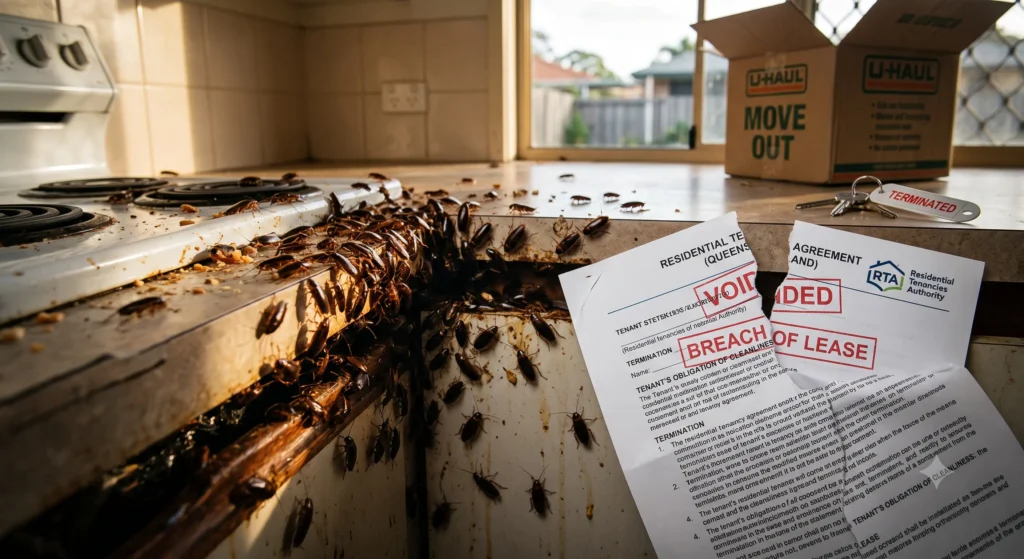
How a severe pest infestation can break a residential lease agreement
Jets Pest Control | Ipswich & South East Queensland
Pest infestations in rental properties are one of the most disputed topics in Queensland tenancy law. Both landlords and tenants have legal obligations — and when those obligations are ignored, the consequences can range from lease termination to compensation claims and bond disputes that run for months.
What Queensland tenancy law says about pests
Under the Residential Tenancies and Rooming Accommodation Act 2008 (Queensland), landlords are required to provide and maintain a rental property in a condition fit for the tenant to live in. This includes keeping the property free of pests at the start of the tenancy. Tenants, in turn, are required to keep the property clean and not cause or permit conditions that would attract pests during the tenancy.
Neither obligation is absolute on its own — the question of who is responsible for a pest infestation almost always comes down to timing and evidence. An infestation present at move-in is typically a landlord obligation. An infestation that developed during the tenancy due to poor housekeeping, food storage habits, or unreported maintenance issues may fall on the tenant.
The three situations where infestation can break a lease
1. Landlord breaches the habitability requirement
If a property becomes seriously infested — cockroaches in food preparation areas, a rodent colony in the walls, or bed bugs in a furnished rental — and the landlord fails to act within a reasonable timeframe after being notified, the tenant may have grounds to claim the property is no longer fit for habitation. Queensland's Residential Tenancies Authority (RTA) defines an urgent repair as something that makes the property unsafe or insecure. Severe pest infestations can qualify.
In this scenario, a tenant who has properly notified the landlord in writing and waited a reasonable period without remediation may be able to apply to QCAT (Queensland Civil and Administrative Tribunal) for an order compelling repairs — or in extreme cases, to end the tenancy without penalty.
2. Tenant breaches the cleanliness obligation
A tenant who creates or worsens a pest infestation through their own behaviour — leaving food waste accessible, failing to report early signs of infestation, or ignoring the landlord's requests for access to treat the property — may be in breach of their lease conditions. Landlords in this situation can issue a Notice to Remedy Breach. If the breach is not remedied within the required timeframe (usually seven days), the landlord can issue a Notice to Leave.
3. Infestation renders the property uninhabitable during the tenancy
In rare but serious cases — for example, a severe rodent infestation or a whole-house bed bug infestation in a furnished property — the dwelling may become temporarily uninhabitable. If the landlord cannot remediate quickly, the tenant may be entitled to a rent reduction for the period the property was not fit to live in, and potentially to terminate the agreement without penalty.
In any dispute about pest responsibility, written documentation is everything. Entry condition reports completed at move-in, written notification to the landlord by email or the RTA's forms, and dated photographs of the infestation all determine who bears the cost. Verbal conversations and retrospective claims carry little weight at QCAT.
Which pests most commonly cause tenancy disputes in Queensland
| Pest | Most common dispute scenario | Responsibility often falls on |
|---|---|---|
| Cockroaches | Infestation expands during tenancy; dispute over whether it was pre-existing | Tenant if no evidence at move-in; landlord if entry condition shows evidence |
| Rodents | Rats or mice enter through structural gaps; tenant reports late or not at all | Landlord for structural entry points; tenant if food storage attracted rodents |
| Bed bugs | Furnished rental or property with carpet; unclear when bugs were introduced | Landlord for furnished items present at move-in; tenant if brought in during tenancy |
| Fleas | Pet-owning tenants; flea treatment required at end of tenancy | Tenant where pets were permitted and lease requires flea treatment on vacating |
| Termites | Active infestation causing structural damage; tenant failed to report early signs | Landlord for damage and treatment; tenant if unreported for extended period |
What landlords must do when an infestation is reported
Once a landlord is notified of a pest infestation in writing, they have a legal obligation to respond promptly. What counts as prompt depends on the severity of the infestation. A minor ant problem allows more time than a cockroach infestation in a kitchen or a confirmed rodent sighting in a property with children or elderly tenants.
- Acknowledge the written notification and confirm you have received it — this establishes the timeline
- Arrange for a licensed pest controller to inspect the property within a reasonable timeframe (typically within seven days for significant infestations)
- Provide the tenant with at least 24–48 hours written notice of the scheduled pest control visit, unless it is an urgent situation
- Arrange treatment and provide the tenant with information about any preparation required (for example, removing food items before a cockroach treatment)
- Follow up to confirm the treatment was effective and document the outcome
A landlord who delays, dismisses, or disputes the tenant's notification without investigation is creating significant legal exposure. QCAT does not look favourably on landlords who require tenants to live with documented pest problems for weeks without response.
What tenants must do when they discover an infestation
- Photograph the infestation with date-stamped images as soon as it is discovered
- Notify the property manager or landlord in writing immediately — email is best for the paper trail
- Do not attempt DIY treatments that could interfere with a professional inspection or make the infestation harder to assess
- Keep the property clean and food stored properly to avoid being held partially responsible
- Follow any preparation instructions given by the pest controller ahead of treatment
- Confirm in writing that treatment occurred and note any follow-up required
At the end of a tenancy, landlords commonly claim bond for pest control costs if the property has an infestation on vacating. These claims are most likely to succeed when: the entry condition report shows no evidence of pests at move-in; the lease specifically requires flea treatment for pet-owning tenants; or there is documented evidence that the tenant created conditions attracting pests. If you are vacating a property and anticipate a pest-related bond dispute, obtaining your own professional pest inspection report before handing back the keys is the best protection.
The case for professional documentation
In tenancy disputes involving pests, a licensed pest controller's written report is far more persuasive than a tenant's photographs or a landlord's assertion. A professional inspection report documents: species identified; evidence of infestation extent and likely duration; probable entry points; and recommended treatment. This report becomes the key evidence in any QCAT proceeding.
Jets Pest Control provides written inspection reports suitable for tenancy documentation. Whether you are a landlord responding to a tenant's notification, or a tenant who needs evidence that an infestation was pre-existing or severe, a documented professional inspection is the strongest foundation for your position.
Do
- Document everything in writing from the first notification
- Use the RTA's Notice to Remedy or urgent repairs process
- Get a licensed pest controller's written report
- Keep copies of all correspondence and reports
- Complete a thorough entry condition report at move-in
Don't
- Rely on verbal agreements or phone calls with no follow-up in writing
- Use DIY pest control before getting the landlord to respond
- Delay reporting — late notification weakens your legal position
- Assume a minor infestation at move-in isn't worth noting on the entry report
- Vacate without getting your own pest inspection if a dispute is likely
Frequently asked questions
Can a tenant leave early without penalty because of a pest infestation?
Who pays for pest control at the end of a tenancy?
What counts as an "urgent repair" for pest infestation in Queensland?
Is a landlord required to provide a pest-free property at the start of a tenancy?
Can a landlord enter a rental property to carry out pest control without notice?
Pest infestation in a rental property? Get a documented inspection.
Jets Pest Control provides written inspection reports for landlords and tenants across Ipswich and South East Queensland. Our reports are suitable for RTA processes and QCAT proceedings.

