
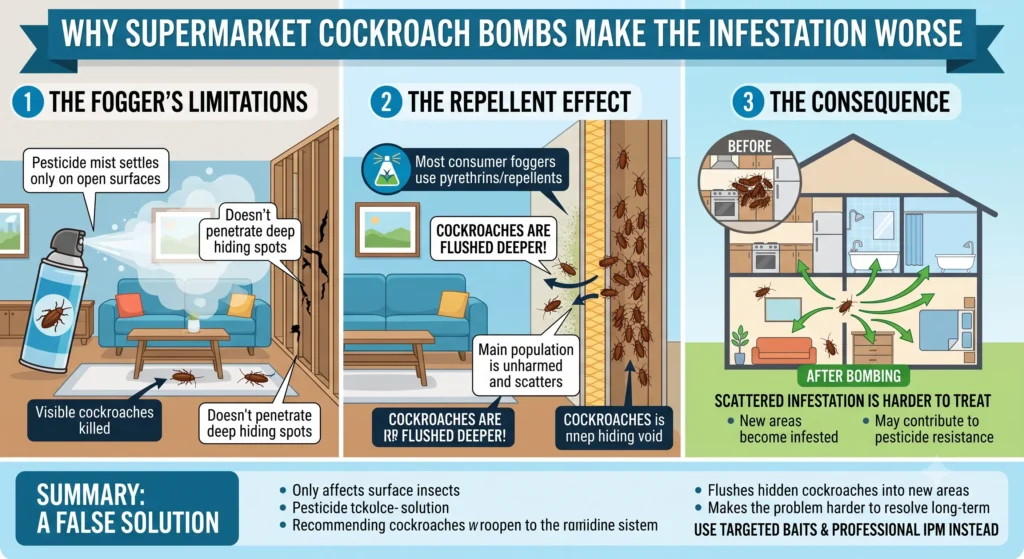
Why supermarket cockroach bombs make the infestation worse
Jets Pest Control — Ipswich & South East Queensland
Cockroach bombs — the fogging canisters sold at hardware stores and supermarkets — are one of the most counterproductive responses to a German cockroach infestation. Rather than eliminating the colony, they scatter it, drive it deeper into wall voids, and prime it for insecticide resistance. Here is what actually happens when you set one off.
What a cockroach bomb actually does to a German cockroach infestation
Total-release foggers work by releasing a fine mist of pyrethrin or permethrin-based insecticide into the room. The active ingredient settles on exposed horizontal surfaces and kills any cockroach that walks through it while the mist is still wet. The problem is that German cockroaches (Blattella germanica) do not live on exposed surfaces. They live in harbourage sites — tight, dark, warm cavities inside appliances, behind cupboard hinges, inside wall voids, beneath the sink, and inside the motor housing of refrigerators. Fogger mist does not penetrate these locations.
The repellent effect
Pyrethroid-based products are strongly repellent to cockroaches at sub-lethal concentrations. When a fogger is detonated in a kitchen, cockroaches deep in their harbourage sites detect the chemical signal and retreat further into wall voids, pipe chases, and roof cavities. This dispersal effect means cockroaches that were previously concentrated in one or two identifiable harbourage sites become distributed across a wider area of the property. A subsequent professional treatment is then significantly harder to execute because the colony's location is no longer predictable.
The cockroaches that do die
The cockroaches killed by a fogger are those that happen to be in exposed positions during the release — foraging on surfaces or caught in transit between harbourage sites. These represent a small fraction of the total population. Research on German cockroach population dynamics consistently shows that the visible, foraging portion of a colony represents ten to twenty percent of the total population. The remaining eighty to ninety percent — eggs, nymphs, and adults in harbourage — are unaffected.
The resistance problem
Repeated sub-lethal exposure to pyrethroids — which is exactly what fogging produces — is one of the primary drivers of insecticide resistance in German cockroach populations. Cockroaches exposed to concentrations below the lethal threshold but above a behavioural-avoidance threshold develop heritable resistance through selection pressure. Populations from homes that have been fogged repeatedly are measurably harder to treat with standard professional formulations than populations from properties that have never been treated at all.
If you have used a cockroach bomb in the two to four weeks before booking a professional treatment, inform your technician. This affects harbourage site prediction, product selection, and application strategy. The dispersed population will require a modified approach — often with a different active ingredient — to achieve effective knockdown.
Why the infestation appears to resolve and then returns worse
The post-fogging cycle follows a predictable pattern. Within twenty-four to forty-eight hours of detonating a fogger, visible cockroach activity drops dramatically. Cockroaches are concealed in repellent-free zones deeper in the property structure. Homeowners interpret this as evidence that the treatment has worked. Three to four weeks later, the population — now distributed across a wider area, and with the eggs from the pre-fogging oothecae hatching — re-emerges. The infestation often appears more widespread than before because the dispersal event has seeded harbourage sites throughout the property rather than in the kitchen alone.
The egg case problem
German cockroach females carry their ootheca (egg case) attached to their abdomen until approximately one to two days before hatching. A single ootheca contains thirty to forty eggs. When a fogger is released, the female retreats with the ootheca intact. The eggs are protected inside the ootheca and are entirely unaffected by the insecticide — they hatch weeks after the treatment regardless. This is why fogging never eliminates an infestation even when it kills a significant number of adults.
No commercially available fogger formulation penetrates the ootheca casing. Even a direct hit with aerosol insecticide does not reliably kill eggs inside a carried egg case. The only way to interrupt the reproductive cycle is to eliminate the adult population at the harbourage site before egg cases are deposited — which requires targeted gel bait and residual insecticide application, not fogging.
What professional cockroach treatment does differently
Harbourage inspection first
Effective German cockroach control begins with identifying exactly where the population is concentrated. A trained technician inspects beneath appliances, inside cupboard hinge mechanisms, within the motor housing of refrigerators, behind the oven cavity, and under the sink. This inspection determines precisely where gel bait should be placed and where residual insecticide should be applied. No effective treatment can be applied without this step — and fogging makes this step harder by dispersing the colony away from its original sites.
Gel bait at the harbourage
Commercial-grade gel bait is placed directly at harbourage site entry points in micro-dose applications. The bait uses protein and carbohydrate attractants that cockroaches seek preferentially over ambient food sources. Cockroaches consume the bait, return to the harbourage, and die there. Other cockroaches then consume the carcasses and the droppings of poisoned cockroaches — a cascade effect that progressively eliminates the population from within the harbourage over seven to fourteen days.
Residual treatment at travel routes
A residual insecticide is applied to surface junctions where cockroaches travel — wall-floor junctions, inside sink cabinet interiors, and behind appliances. The residual effect typically persists for four to eight weeks, ensuring newly hatched nymphs from any surviving egg cases are eliminated before they can establish new harbourage sites. This multi-mechanism approach — gel bait killing the existing population plus residual insecticide eliminating hatchlings — is why professional treatment achieves lasting results where fogging does not.
Jets Pest Control applies commercial-grade gel bait directly to harbourage sites and residual insecticide to travel routes across kitchen and bathroom areas. We identify every harbourage site before applying any product. Call 1300 566 569 to book a kitchen inspection and cockroach treatment, or request a quote for your property.
Do
- Book a professional treatment at the first sign of cockroach activity
- Seal food in airtight containers to remove competing food sources
- Fix leaking pipes — German cockroaches require a water source
- Clean thoroughly before the technician arrives, but do not spray anything
- Follow post-treatment instructions precisely — do not clean treated surfaces
- Tell your technician if you have used a fogger recently
Don't
- Use cockroach bombs or foggers — they scatter the colony and induce resistance
- Use aerosol sprays in harbourage areas — the repellent effect worsens dispersal
- Leave pet food out overnight — it is a primary cockroach attractant
- Deep clean immediately after gel bait is placed — it removes the bait
- Assume the problem is solved when visible activity drops — the population is hiding
- Wait until the infestation is severe — German cockroach populations double every six to eight weeks
Frequently asked questions
Do cockroach bombs work at all?
Why does my kitchen look cockroach-free after a bomb but then they come back?
Can I use a cockroach bomb before professional treatment to reduce numbers?
What is the fastest way to get rid of a German cockroach infestation?
Are cockroach gels from the hardware store as effective as what a professional uses?
Got cockroaches? Get professional treatment that works.
Jets Pest Control provides targeted cockroach treatments across Ipswich and South East Queensland — treatments that reach where aerosols cannot.

