
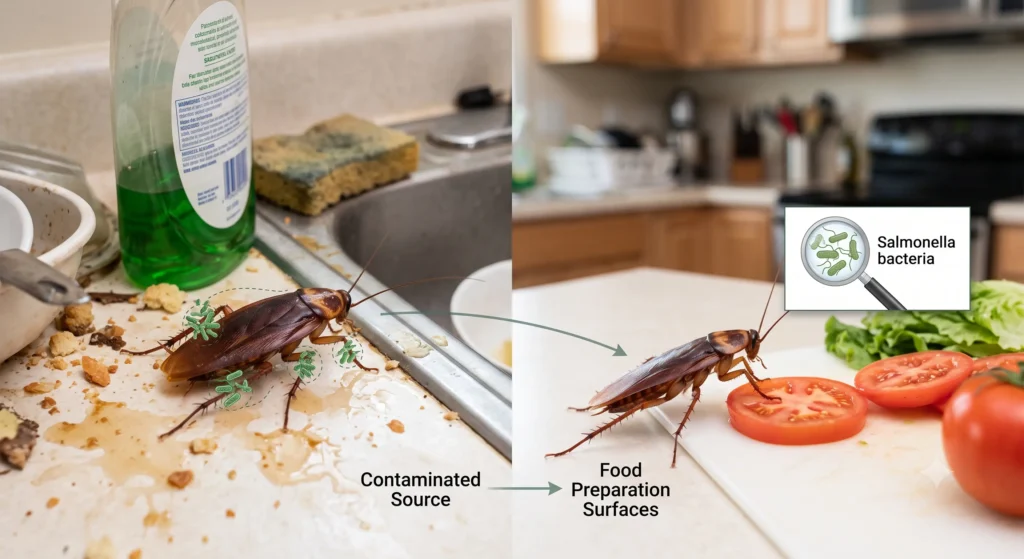
The link between household cockroaches and Salmonella food poisoning
Jets Pest Control — Ipswich & South East Queensland
A cockroach walking across your kitchen bench is not just unpleasant — it is a direct Salmonella contamination event. Every surface the cockroach touches picks up whatever it has walked through: drain sludge, sewage, rotting food, dead animals. Cockroaches are mechanical vectors of foodborne disease, and Salmonella is the pathogen most consistently isolated from their bodies and droppings in Australian homes.
How cockroaches carry and spread Salmonella
Cockroaches do not produce Salmonella — they acquire it from their environment and carry it on their legs, bodies, and in their digestive tracts. German cockroaches (Blattella germanica), the most common species infesting Brisbane and Ipswich kitchens, are omnivorous scavengers that move between sewage systems, garbage, wall voids, and food preparation areas within a single night.
The contamination pathway
The contamination pathway is direct. A cockroach forages in a drain, a bin, or a wall void containing decomposing organic matter contaminated with Salmonella spp. bacteria. The bacteria adhere to the tarsal pads on the cockroach's legs and to the hairs on its body. It then walks across food, food preparation surfaces, crockery, cutlery, or any item that will make contact with food. The bacteria are deposited on those surfaces, where they survive for hours — or days, in moist conditions. A person eating contaminated food then ingests the bacteria, and Salmonella infection follows.
Cockroach droppings and regurgitation fluid are equally problematic. German cockroaches produce distinctive dark droppings that accumulate in harborage areas — behind the oven, inside cupboard hinges, beneath the refrigerator. These droppings contain viable Salmonella that can be disturbed and dispersed by air movement, cleaning activity, or further cockroach traffic.
Why Salmonella is the key concern
Multiple bacterial species have been isolated from cockroaches collected in food-handling environments, but Salmonella is the pathogen most reliably associated with cockroach presence in peer-reviewed studies. Australian cockroach populations sampled from residential and commercial kitchens consistently return Salmonella-positive results — particularly German cockroaches, which have an affinity for warm, moist environments immediately adjacent to food storage and preparation areas.
Symptoms and severity
Salmonella gastroenteritis presents with fever, abdominal cramping, diarrhoea, nausea, and vomiting, typically beginning six to seventy-two hours after consuming contaminated food. In healthy adults the illness usually resolves within four to seven days without treatment. However, in young children, the elderly, pregnant women, and immunocompromised individuals, Salmonella infection can progress to severe dehydration, bacteraemia, and complications requiring hospitalisation. These are often the most vulnerable members of a household — the people who cannot afford a food safety incident.
The asymptomatic household problem
One of the specific problems with cockroach-sourced Salmonella in a household setting is attribution. When one person in a household develops gastroenteritis, the cause is rarely traced back to a cockroach infestation. It is assumed to be a restaurant meal, a takeaway order, or a viral illness. The cockroach population in the kitchen continues to grow undisturbed, and the household remains at ongoing risk of repeated low-level contamination events — any one of which could produce a serious illness in a vulnerable family member.
German cockroach droppings accumulate in concentrated deposits in harborage sites — behind appliances, inside cupboard hinges, under the sink. These deposits contain viable bacteria and cockroach allergens simultaneously. Regular cleaning removes visible droppings but does not address the cockroach population producing them. A professional treatment targeting the harborage sites is required to break the cycle.
German cockroaches: why kitchen infestations are high-risk
German cockroaches are the species of greatest concern for Salmonella transmission in South East Queensland homes. Unlike Australian cockroaches (Periplaneta australasiae) or American cockroaches (Periplaneta americana), which are larger outdoor-to-indoor species that tend to forage opportunistically rather than establishing indoor colonies, German cockroaches live exclusively indoors and breed rapidly in close proximity to food.
Population dynamics
A single female German cockroach produces an ootheca (egg case) containing approximately thirty to forty eggs. Under favourable conditions — warmth, moisture, available food — a population can double in six to eight weeks. An infestation of fifty cockroaches can become five hundred within a few months. This population density dramatically increases the number of contamination events occurring in the kitchen each night, as cockroaches forage across every surface during the hours between midnight and 5am when the kitchen is unoccupied.
Why you don't see them
German cockroaches are strongly photophobic — they avoid light and remain concealed in harborage sites during daylight hours. A kitchen with a serious German cockroach infestation may present no visible cockroaches during the day. Homeowners are often unaware of the infestation's true scale until it is revealed by a professional inspection. The first sign people typically notice is a single cockroach visible at night, or the distinctive musty odour of cockroach aggregation pheromones — by which point the population is already established.
German cockroaches are not solitary explorers — if one is visible, it is almost always a sign of population pressure in the harborage site. Visible cockroaches during daylight are a particular indicator of severe infestation. Gel bait and residual treatment must be applied to all harborage areas, not just the locations where cockroaches have been seen.
Other pathogens cockroaches carry alongside Salmonella
Salmonella is the most well-documented cockroach-associated pathogen, but it is not the only one. German cockroach populations sampled in kitchen environments have also tested positive for:
- Escherichia coli — including pathogenic strains that cause gastroenteritis and urinary tract infections
- Campylobacter — a leading cause of diarrhoeal illness in Australia
- Listeria monocytogenes — particularly dangerous for pregnant women
- Staphylococcus aureus — capable of producing heat-stable toxins that persist even after food is cooked
- Klebsiella pneumoniae — associated with respiratory and urinary tract infections
Beyond bacterial pathogens, cockroach body parts, shed cuticle, droppings, and saliva are potent allergens. Cockroach allergens are a leading cause of year-round asthma and allergic rhinitis in children, particularly in households with chronic German cockroach infestations. The combined public health burden — foodborne illness, respiratory disease, and allergen exposure — makes cockroach control in kitchens one of the highest-priority pest management objectives in a family home.
Why DIY treatment rarely eliminates a German cockroach infestation
Consumer sprays displace, not eliminate
Pyrethrin-based aerosol sprays available from supermarkets are contact killers — they kill cockroaches that are directly sprayed but have minimal residual effect. More critically, the repellent properties of these products cause cockroaches to scatter from the treated area and retreat deeper into wall voids, behind appliances, and into other harborage sites. The population is not reduced — it is redistributed and becomes more difficult to access. Repeated aerosol use in a kitchen with an established German cockroach infestation typically makes the infestation harder to treat professionally because it conditions the population to avoid exposed surfaces.
Gel bait without harborage identification fails
Gel baits marketed for consumer use are effective in principle — cockroaches consume the bait and die — but their placement requires knowledge of the harborage sites and foraging pathways. Placing gel bait in the middle of a shelf rather than within the harborage site itself results in low uptake. Professional gel bait formulations also use different active ingredients and attractants than consumer products, and are applied in precisely placed micro-doses to maximise consumption by the cockroach population.
Jets Pest Control uses commercial-grade gel bait applied directly to harborage sites combined with residual insecticide treatment of wall junctions, under-sink cavities, appliance gaps, and cupboard hinges. Our approach eliminates the colony at the source rather than displacing it. Call 1300 566 569 to book a kitchen inspection and treatment, or request a quote for your property.
What professional cockroach treatment involves
Harborage identification and inspection
An effective German cockroach treatment begins with a thorough inspection to identify harborage sites. These are consistently found in specific locations: behind and beneath the refrigerator, inside the cavity behind the oven, under the dishwasher, within the hinge mechanism of kitchen cupboards, beneath the sink, inside the motor housing of refrigerators, and within the wall cavity behind plumbing penetrations. Each harborage site is identified and targeted.
Gel bait application
Commercial gel bait is applied in small dots directly at harborage site entry points. The bait uses food attractants — proteins and carbohydrates — that cockroaches preferentially seek over ambient food sources. Cockroaches consume the bait and return to the harborage, where they die. Horizontal transmission occurs when other cockroaches consume the carcasses or the droppings of poisoned cockroaches, progressively eliminating the population from within the harborage.
Residual treatment
A residual insecticide is applied to surface junctions where cockroaches travel — wall-floor junctions, under-sink cabinet interiors, and behind appliances. Cockroaches crossing the treated surface absorb the insecticide through their cuticle. The residual effect typically persists for four to eight weeks, ensuring newly hatched cockroaches from any egg cases that survived the initial treatment are eliminated before they can establish new harborage sites.
Do
- Book a professional cockroach treatment at the first sign of activity
- Clean thoroughly before treatment to remove competing food sources
- Seal food in airtight containers to reduce cockroach food access
- Fix any leaking pipes — German cockroaches need a water source
- Remove clutter from under the sink and behind appliances
- Follow the technician's post-treatment instructions precisely
Don't
- Use aerosol sprays immediately before professional treatment — they scatter cockroaches
- Deep clean after gel bait is placed — it removes the bait
- Assume a single treatment resolves a severe infestation without a follow-up
- Leave pet food out overnight — it is a primary cockroach food source
- Ignore cockroach activity near food preparation areas as a cosmetic issue
- Use DIY approaches on German cockroach infestations in kitchens — displacement worsens the outcome
Frequently asked questions
Can cockroaches cause Salmonella poisoning?
How do I know if cockroaches have contaminated my food?
Are German cockroaches the most dangerous cockroach for food contamination?
How long does cockroach contamination survive on surfaces?
Cockroach infestation? Protect your household's health.
Jets Pest Control eliminates cockroach infestations at the source across Ipswich and South East Queensland — professional treatments that stop contamination risk.

