
Spider Identification · South East Queensland
The Difference Between Harmless Huntsman Spiders and Dangerous Species
South East Queensland is home to a wide range of spider species, the majority of which pose no meaningful medical risk to humans. Yet the fear response most people experience when they encounter a large spider is the same regardless of whether that spider is genuinely dangerous. Understanding the key differences between species allows you to respond appropriately — calmly removing a harmless Huntsman rather than panicking, while taking the correct precautions when a genuinely hazardous species is involved.
The most common spider species in SEQ homes
- Appearance
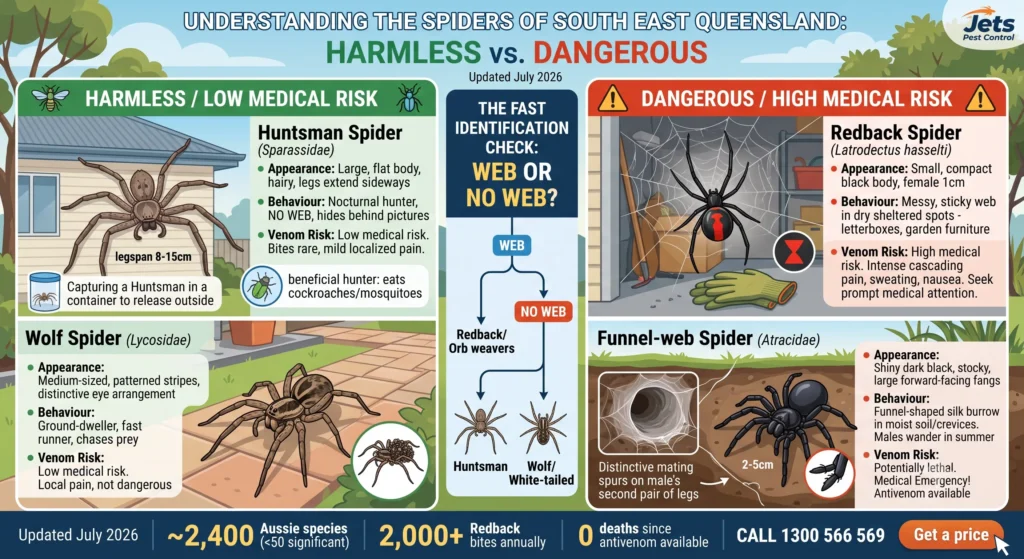
- Large, flat body. Legspan typically 8–15 cm. Brown or grey, often with a slightly hairy texture. Legs extend sideways rather than beneath the body.
- Behaviour
- Nocturnal hunter — does not build a web. Wanders at night, hides in dark flat spaces during day (behind pictures, sun visors, under bark). Fast-moving when disturbed.
- Venom risk
- Not medically significant. Bites are rare and cause at most mild localised pain and swelling. No antivenom required.
- Where found
- Inside homes, behind wall hangings, inside car cabins, under bark in the garden. Extremely common across SEQ year-round.
- Appearance
- Small, compact black body. Female has a distinctive red or orange stripe on the upper abdomen and a red hourglass marking on the underside. Male is much smaller and less distinctively marked.
- Behaviour
- Builds a messy, sticky web in dry, sheltered spots — garages, under garden furniture, inside electrical boxes, wheel arches. Sedentary; stays in the web.
- Venom risk
- Highly medically significant. Bite causes intense, escalating pain, sweating, nausea. Antivenom is available and effective. Seek medical attention promptly.
- Where found
- Garages, outdoor furniture, letterboxes, cluttered areas near walls and fences. Common throughout SEQ.
- Appearance
- Medium to large body (2–5 cm body length). Shiny, dark black or dark brown. Stocky with pronounced fangs. Males have a distinctive mating spur on the second pair of legs.
- Behaviour
- Builds a funnel-shaped silk burrow in moist, sheltered soil or rock crevices. Males wander in summer to find mates and may enter homes and garages.
- Venom risk
- Potentially lethal — a bite from a male Sydney Funnel-web is a medical emergency. Pressure immobilise and call 000. Antivenom is available.
- Where found
- Hinterland areas of SEQ including regions near Ipswich, Lockyer Valley, and the ranges. Less common in urban areas but present in bushy residential properties.
- Appearance
- Slender, cylindrical body (1–2 cm). Dark grey to black with a distinctive white tip at the end of the abdomen. Two pairs of faint white spots may be visible along the abdomen.
- Behaviour
- Does not build a web — wanders and hunts other spiders. Hides in clothing, shoes, and stored items during the day. Common in bedding and garments left on the floor.
- Venom risk
- Bite causes localised burning pain and swelling. Historical claims of necrosis are not supported by current research — bites are painful but not typically dangerous in healthy adults.
- Where found
- Bedrooms, bathrooms, laundries. Very common in SEQ homes, particularly where clothing is left on the floor.
- Appearance
- Medium-sized (1–3 cm body). Brown and grey with a distinctive pattern of stripes or spots. Eyes arranged in three rows — the large pair reflects light at night.
- Behaviour
- Ground-dweller. Does not build a web — actively chases prey. Often seen running across floors, patios, and garden paths. Females carry egg sacs and spiderlings on their back.
- Venom risk
- Not medically significant. Bites may cause localised pain and itching but are not dangerous. Generally non-aggressive unless handled.
- Where found
- Garden beds, under debris, on garage floors, patios. Commonly mistaken for a Funnel-web due to similar colouring.
- Appearance
- Striking yellow, white, and black banded abdomen. Builds a large, circular web with distinctive zigzag silk bands arranged in a cross pattern.
- Behaviour
- Builds webs in gardens, particularly among low vegetation and shrubs. Sits at the centre of the web with legs extended in pairs along the cross bands.
- Venom risk
- Not medically significant. Will only bite if directly handled; venom causes mild, short-lived pain.
- Where found
- Gardens and yards across SEQ. Very commonly encountered near hedges, vegetable gardens, and flowering plants.
The fastest identification check: web or no web?
The single most useful identification question is whether the spider you have found is in a web. This immediately narrows down the possibilities significantly:
| Observation | Most likely species | Medical risk |
|---|---|---|
| Large, fast spider on wall or ceiling — no web | Huntsman spider | Very low |
| Small dark spider in messy sticky web near ground or in sheltered spot | Redback spider | High — do not reach in |
| Spider running across floor — no web | Wolf spider or White-tailed spider | Low to moderate |
| Dark, stocky spider in or near soil burrow | Funnel-web or trapdoor spider | Treat as high risk |
| Large decorative web in garden with banded spider at centre | St Andrew's Cross or Golden Orb | Very low |
Why Huntsman spiders are so commonly misidentified as dangerous
The Huntsman spider's sheer size is responsible for much of the fear it generates. A fully grown female Huntsman with a 15 cm legspan encountered unexpectedly on the ceiling of a bedroom or behind a sun visor in a car is a deeply alarming experience for most people. Their speed compounds the problem — Huntsmans are fast, erratic movers when disturbed, which activates the same fear response as a threat.
In reality, Huntsman spiders are beneficial in the home environment. They consume mosquitoes, cockroaches, and other insects, and have no interest in humans. They will not bite unless directly grabbed and held, and even then their venom causes only mild, transient pain in most cases. The correct response to a Huntsman in the home is to capture it in a large container with a piece of cardboard underneath and release it outside — or simply leave it where it is if it is in an accessible area outside human traffic.
The species that should prompt genuine caution are the Redback spider and, in bushland areas, the Funnel-web. Both are far less visually intimidating than the Huntsman, which means they are often noticed later and handled less carefully.
Redback identification: what to look for
The Redback is the species you are most likely to encounter in a backyard or garage setting that carries real medical risk. Key identification points:
- Size: Female body is approximately 1 cm — much smaller than a Huntsman. Males are significantly smaller again and not medically significant.
- Colour: Black body with a conspicuous red or orange stripe on the upper abdomen. The underside has a red hourglass marking. Young females may have white markings instead of red.
- Web: Messy, sticky, irregular web — not the neat circular web of garden orb weavers. The web often has a funnel or retreat at the top where the spider rests.
- Location: Always in a dry, sheltered spot — under garden furniture, inside letterboxes, in door mirror housings, under pot plant rims, in electrical junction boxes.
Do not apply a pressure immobilisation bandage — this is not the correct treatment for Redback bites (pressure immobilisation is for Funnel-web and snake bites only). Apply ice or a cold compress to the bite site to manage pain. Seek medical attention promptly — antivenom is available and very effective. The bite causes intense, escalating pain that may spread from the bite site and worsen over hours. It is not immediately life-threatening in healthy adults but requires treatment.
Funnel-web identification and what to do
Funnel-web spiders are present in parts of South East Queensland, particularly in the hinterland areas around Ipswich, the Lockyer Valley, and the Scenic Rim. They are less common in fully urbanised areas but are found in bushy residential properties, particularly those backing onto creek lines or bushland.
Key identification points for Funnel-webs:
- Size: Medium to large body — female typically 3–4 cm body length, male smaller at 2–3 cm.
- Colour: Shiny, dark black or very dark brown. The legs and chelicerae (fangs) are glossy.
- Fangs: Prominent, forward-facing fangs — visible if the spider is in a defensive posture. A Funnel-web rearing up is a sign of aggression; do not approach.
- Web: Funnel-shaped silk tube in moist soil, under rocks, in logs, or in rockeries. Silk trip-lines extend from the entrance.
- Behaviour: Males wander in summer (December–March) and may enter homes and garages at night.
If you find what you believe is a Funnel-web spider: do not attempt to handle it, kill it, or capture it yourself. Place a glass or large container over it and call a pest professional or call 000 if a bite has occurred. Funnel-web bites are medical emergencies requiring pressure immobilisation bandaging and immediate hospitalisation.
Jets Pest Control provides comprehensive spider treatments for homes and garages across Ipswich and South East Queensland, including web removal, targeted application to all known harbourage points, and advice on species identification. If you have found a spider you cannot identify with confidence, or if you have a recurring spider problem, call 1300 566 569 to arrange an inspection and treatment.
Frequently asked questions
Are Huntsman spiders dangerous?
How do I tell the difference between a Huntsman and a Redback spider?
What is the most dangerous spider in Queensland?
What should I do if I find a Redback spider in my home?
Can Funnel-web spiders be found in Ipswich?
Book a professional spider treatment
Jets Pest Control provides comprehensive spider treatments covering homes, garages, and full property perimeters across Ipswich and South East Queensland.

