
Queensland Biosecurity Law — Homeowner Guide
Mandatory Biosecurity Queensland Reporting Rules for Homeowners
If you find a suspected fire ant nest in Queensland's declared biosecurity zone — which includes all of Ipswich City — you are legally required to report it to Biosecurity Queensland on 13 25 23 or at fireants.org.au. Failure to report can result in penalties up to $10,000. Free government treatment may be available.
What is Queensland's fire ant biosecurity zone?
Queensland's fire ant biosecurity zone is a declared area under the Biosecurity Act 2014 (Qld) established to contain and eradicate Solenopsis invicta — the red imported fire ant — before it can permanently establish across Australia. The zone is managed by Biosecurity Queensland and covers a significant and expanding area of South East Queensland.
As of 2026, the declared zone includes all of:
- Ipswich City
- Logan City
- Redland City
- Scenic Rim Regional Council
- Parts of Brisbane City, Gold Coast, Lockyer Valley, Somerset, and Moreton Bay
The zone boundaries are regularly updated as the program progresses. You can check whether your specific suburb is within the zone at fireants.org.au. If you are unsure, assume you are in the zone and report any suspected nest immediately.
The General Biosecurity Obligation explained
The Biosecurity Act 2014 (Qld) imposes a General Biosecurity Obligation (GBO) on every person — including homeowners, renters, and businesses — who deals with a biosecurity matter. Under the GBO, you are required to take all reasonable and practical steps to prevent or minimise the biosecurity risk.
For fire ants on your property, this means:
Report promptly
Report suspected fire ant nests to Biosecurity Queensland as soon as reasonably practicable after discovery. Do not wait. The faster a nest is reported, the faster it can be treated and the lower the risk of spread.
Do not disturb or self-treat
Do not attempt to treat the nest yourself with any household product, fuel, or liquid. Self-treatment risks causing the colony to scatter and establish new satellite nests, potentially spreading fire ants to neighbouring properties.
Control movement of materials
Do not move soil, mulch, turf, potted plants, or machinery from your property without inspection if you suspect fire ant infestation. Movement of infested materials is one of the primary ways fire ants spread to new areas.
Comply with biosecurity directions
If a Biosecurity Queensland officer issues you a biosecurity direction — for example, requiring you to treat an area, restrict movement of materials, or provide access for inspection — you must comply. Failure to comply with a direction is a separate offence from the original GBO breach.
How to report a fire ant nest in Queensland
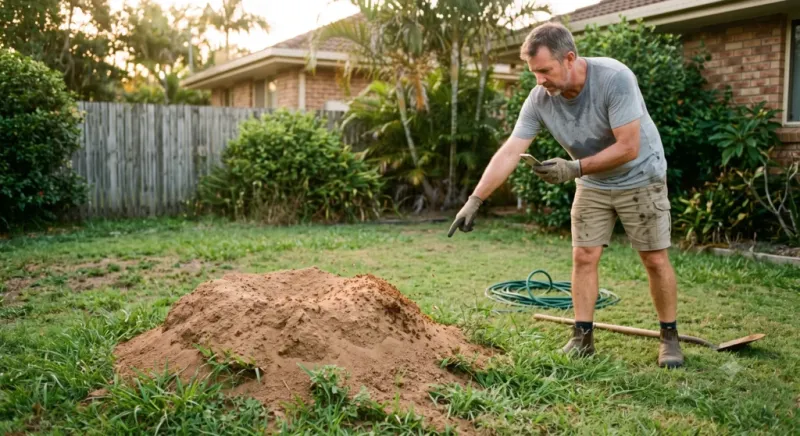
Reporting takes only a few minutes. Before you do, do not disturb the nest — keep people and pets away from the area and mark the location if safe to do so.
-
Call 13 25 23 — the Fire Ant Contact Centre
Available business hours. Officers will take your details, confirm the location, and classify the report. For argent situations involving risk to people or livestock, let them know and they can escalate the response.
-
Report online at fireants.org.au
The online portal allows you to submit photos, a map pin, and a description of what you have found. This is the recommended method for non-urgent reports and means the information is logged directly into the system.
-
Provide accurate location details
The more precise your location information, the faster officers can attend. Include your street address, the location of the nest within the property (e.g., rear lawn, near the garden shed), and the approximate size of the mound if you can observe it safely from a distance.
-
Take a photo if safe to do so
A clear photo from a safe distance helps Biosecurity Queensland officers assess whether the mound is likely to be fire ants before attending. Do not crouch close to the mound for the photo — fire ants respond aggressively to vibration near the nest.
Movement controls for soil and garden materials
One of the most critical biosecurity rules in the fire ant zone concerns the movement of soil, mulch, turf, potted plants, and earth-moving equipment. Fire ants can nest in these materials and be transported to new areas during garden landscaping, construction, or plant sales.
Within the fire ant biosecurity zone, the following materials require care before movement:
- Topsoil and fill: Must be sourced from a declared pest-free supplier or inspected before use. Unverified soil from unknown sources is a major fire ant spread risk.
- Turf: All turf sold or moved within the zone must comply with movement controls and may require inspection certificates from certified turf farms.
- Mulch and compost: Movement of garden mulch or green waste from potentially infested areas can carry fire ant eggs and queens. Do not use mulch from unknown sources in the zone.
- Potted plants: Plants in soil containers can harbour fire ant colonies and queens. Inspect the soil of potted plants before moving or purchasing them in the zone area.
- Earth-moving machinery: Excavators, bobcats, and similar equipment that have worked in potentially infested areas should be inspected and cleaned before moving to a new site. Mud and soil in the tracks and undercarriage may carry fire ants.
If you are unsure whether materials from your property might carry fire ants, contact Biosecurity Queensland on 13 25 23 before moving them. Officers can advise on whether an inspection or movement declaration is required for your specific situation. It is much better to ask first than to face a penalty for non-compliant movement.
What happens after you report?
Once you submit your report, a Biosecurity Queensland officer will review it and classify the likelihood based on your description and photos. If fire ant activity is suspected, an officer will attend your property to confirm the identification.
If fire ants are confirmed:
- The nest is treated by government officers at no cost to you as part of the state eradication program
- Treatment typically involves Fipronil direct nest injection, granular bait application, or the Two-Step bait program depending on your location within the zone
- A follow-up inspection may be scheduled to confirm eradication
- You may be placed on a monitoring program for your address
Response times vary based on program activity in your area. In high-priority zones close to known infestations, response can be within one to three business days. In outer areas, it may take longer. If you cannot wait because of risk to children, tenants, or livestock, contact Jets Pest Control — we are accredited to treat fire ant nests using the same approved methods while you await government follow-up.
Penalties for non-compliance
Queensland's fire ant biosecurity obligations carry real penalties. These are not theoretical — Biosecurity Queensland has enforcement officers with the authority to inspect properties, issue directions, and pursue penalty infringement notices.
- Failure to report: Up to $10,000 penalty for individuals who fail to report a suspected fire ant nest in the declared zone as soon as reasonably practicable
- Non-compliant soil or material movement: Up to $10,000 for moving soil, turf, or other restricted materials from an infested area without required inspection or declaration
- Failure to comply with a direction: Separate offence from the underlying GBO breach — officers can issue formal directions and non-compliance is an additional penalty
- Deliberate spread: Intentionally spreading fire ants is treated as a serious biosecurity offence with significantly higher penalties
The intent of Queensland's biosecurity legislation is not punitive toward homeowners who act in good faith. Most enforcement action is taken against repeated failures to report, non-compliant commercial soil movement, or deliberate avoidance of the obligations. Homeowners who discover a nest, report it promptly, and do not disturb it are acting exactly as the law requires — and government treatment is typically available at no cost to them.
When professional pest management is needed
In most cases, reporting to Biosecurity Queensland and awaiting government treatment is the correct first step. However, there are situations where engaging a licensed, accredited pest manager like Jets Pest Control is appropriate or necessary:
- Urgent risk situations: If the nest poses an immediate risk to children, elderly residents, or people with known anaphylaxis risk to insect stings, or if livestock or pets are at risk, a licensed pest manager can attend and treat the nest urgently using APVMA-registered products
- Multiple or large infestations: Properties with multiple confirmed fire ant mounds or a large-scale infestation may benefit from professional property-wide bait treatment in addition to government spot treatment
- Property sales and compliance certificates: Some property transactions within the fire ant zone may require a property compliance statement or inspection from an accredited professional
- Commercial properties and rental properties: Landlords and commercial property managers may have duty of care obligations that require prompt professional treatment regardless of government response times
Jets Pest Control holds current accreditation for fire ant management under Queensland biosecurity protocols. We use only APVMA-registered Fipronil-based products and Two-Step bait programs approved for use in the declared biosecurity zone. We serve Ipswich, Springfield, Redbank Plains, Ripley, Collingwood Park, Goodna, and surrounding suburbs. Call us on 1300 566 569 for urgent fire ant treatment or to discuss property compliance requirements.
Frequently asked questions
Am I legally required to report fire ants in Queensland?
What is the General Biosecurity Obligation for homeowners?
Can I move soil or turf from my property in the fire ant zone?
What does Biosecurity Queensland do after I report?
What happens if I don't report fire ants?
Need urgent fire ant treatment?
Jets Pest Control is accredited for fire ant management under Queensland biosecurity protocols. We treat using approved Fipronil methods while you await government follow-up.

