
Fire Ant Biosecurity — Ipswich & Brisbane
Found a Fire Ant Nest in Your Backyard? Here's Exactly What to Do
Step away from the nest immediately. Fire ants attack in the hundreds within seconds of nest disturbance. Do not kick, dig, or pour anything on it. Move all people and pets to a safe distance, then follow the steps below.
Step-by-step: what to do in the next 30 minutes
- 1
Move everyone away from the area
Back away slowly without stamping your feet or making sudden movements near the mound. Vibration triggers fire ants to boil out of the nest and sting anything in contact with the ground. Take children and pets inside. Place a visible marker — a traffic cone, bucket, or stick — at a safe distance to warn others.
- 2
Check for stings on yourself and others
Fire ant stings produce an immediate sharp burning sensation. Within 8 to 24 hours, small white or fluid-filled pustules form at each sting site. For minor stings: wash the area with soap and water, apply a cold pack, and avoid scratching the pustules (scratching risks secondary infection). For anyone showing signs of an allergic reaction — widespread hives, swelling of the face or throat, difficulty breathing, dizziness — call 000 immediately. Anaphylaxis from fire ant stings is a documented risk.
- 3
Report the nest to Biosecurity Queensland
If your property is within Queensland's declared fire ant biosecurity zone — which includes Ipswich, Redlands, Logan, Scenic Rim, and much of Greater Brisbane — reporting is legally required under the Biosecurity Act 2014 (Qld). Call the Fire Ant Contact Centre on 13 25 23 (Monday to Friday, 8 am to 5 pm) or submit a report online at fireants.org.au at any time. Provide your address, a description of the mound, and the approximate size. A Biosecurity Queensland officer may attend to verify and treat the nest at no charge to you.
- 4
Keep the area clear while awaiting treatment
Do not mow over the nest, dig in that garden bed, or allow children to play near the area. If rain is forecast and you are concerned about ants spreading, erect a temporary barrier (plastic sheeting around the perimeter) but do not disturb the mound itself. Disturbing a nest before treatment causes the colony to split and relocate — multiplying the problem.
- 5
Arrange professional treatment if the government program cannot respond in time
Biosecurity Queensland's free treatment service prioritises the eradication program, but response times vary. If you have an urgent situation — fire ants near a children's play area, active garden or pool equipment, or a tenant or elderly person at risk — contact a licensed pest manager with specific fire ant accreditation. Jets Pest Control uses Fipronil-based direct nest injection and Two-Step bait programs approved under Queensland biosecurity guidelines.
What not to do
These approaches will make the problem worse — or put you at serious risk
- Do not pour boiling water on the nest. It kills surface ants but cannot reach the queen, which is typically 30 to 50 cm underground. The colony survives and relocates.
- Do not use petrol, diesel, or kerosene. Highly flammable, environmentally illegal, and ineffective against the queen. This approach creates a fire risk and a contaminated soil problem while the colony survives.
- Do not use standard household insect spray. Surface sprays trigger defensive swarming, put you at stinging risk, and do not penetrate to the queen's chamber. Contact kill only — the colony rebuilds within weeks.
- Do not dig up or disturb the mound. Disturbing the nest causes the colony to scatter and establish multiple new satellite nests across your yard and into neighbouring properties.
- Do not ignore it and hope it goes away. Fire ant colonies do not disperse on their own. A single mated queen can establish a colony that grows to 200,000 workers within 12 months. The colony will spread.
How to identify a fire ant nest in Queensland
Not every ant mound is a fire ant nest, but the consequences of getting it wrong are severe enough that you should treat any unfamiliar mound as potentially fire ants until confirmed otherwise.
Signs it may be a fire ant nest
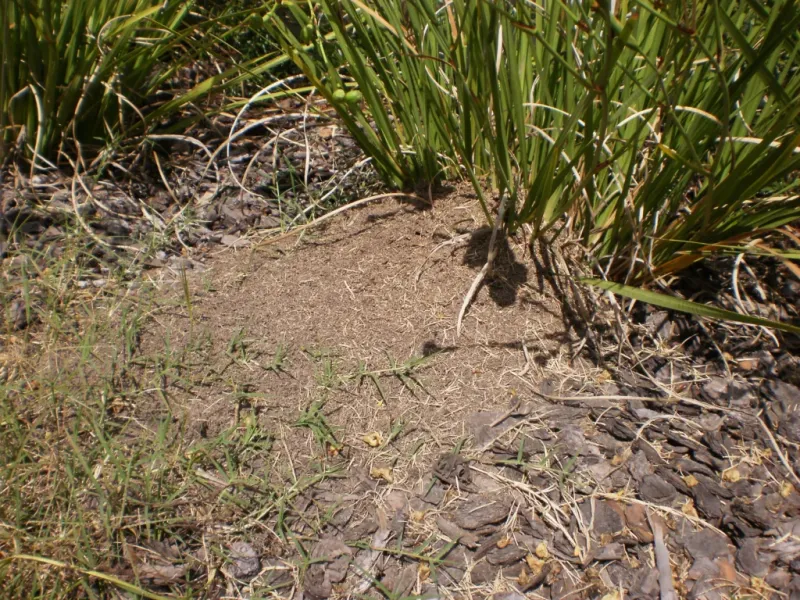
- An irregular, dome-shaped mound of loose, fluffy soil, 10 to 40 cm high
- No obvious entry hole at the top (unlike native ant species)
- Mound appeared after rain or following soil disturbance
- Located in a sunny, open area — lawn, garden bed, near footpaths, or around irrigation lines
- Ants are reddish-brown with a darker abdomen, 2 to 6 mm long, fast-moving and erratic
- Ants begin pouring out rapidly and stinging when the mound is touched or the surrounding soil is vibrated
Signs it is probably a native ant nest
- A defined entry hole or crater at the top of the mound
- Ants are uniformly black or very dark
- Ants are slow to react and do not swarm aggressively
- The mound is hard-packed rather than loose and fluffy
If you are unsure whether you have found fire ants or a native species, do not disturb the mound. Call Jets Pest Control on 1300 566 569 for a fire ant identification and assessment, or submit a photo report via the Biosecurity Queensland online portal at fireants.org.au. Our technicians are trained and accredited in fire ant identification and treatment under Queensland biosecurity requirements.
Your legal obligations in the fire ant biosecurity zone
Queensland's fire ant biosecurity zone covers a significant and growing area of South East Queensland, including all of Ipswich City, Logan City, Scenic Rim Regional Council, Redland City, and parts of the Lockyer Valley, Somerset, and Gold Coast. The zone is regularly updated — check your suburb at fireants.org.au.
If your property is inside the zone, the Biosecurity Act 2014 (Qld) imposes a General Biosecurity Obligation (GBO) on every landholder. This means you are legally required to:
- Report a suspected fire ant nest to Biosecurity Queensland as soon as reasonably practicable
- Not take actions that could spread fire ants (including moving soil, mulch, turf, or garden equipment from an infested area without inspection)
- Comply with movement controls on materials in and out of the zone
Penalties for breaching biosecurity obligations can reach $10,000 for individuals and higher for businesses. The intent of the law is not punitive — most homeowners who report promptly are not penalised — but non-compliance that results in the spread of fire ants is taken seriously by enforcement officers.
If your property is in the biosecurity zone and you plan to move topsoil, mulch, turf, potted plants, or machinery, you may require a movement declaration or inspection. Contact Biosecurity Queensland on 13 25 23 before moving any materials to avoid fines of up to $10,000.
What happens after you report to Biosecurity Queensland
Once you submit a report, a Biosecurity Queensland officer will assess the report and classify it. If confirmed as fire ants, the mound will be treated by government officers as part of the state eradication program — at no cost to you. Treatment typically involves Fipronil direct nest injection, granular bait application, or a combination of the Two-Step program depending on your location within the zone.
Response times vary depending on program activity in your area. In high-priority zones, response can be within days. In outer areas, it may take longer. If you cannot wait — because of risk to children, tenants, or livestock — a licensed pest manager can treat the nest using the same approved active ingredients while you await government follow-up.
Fire ant treatment options available through Jets Pest Control
Jets Pest Control technicians hold current accreditation for fire ant management under Queensland biosecurity protocols. We offer:
- Fire ant nest identification: Positive identification of fire ant nests versus native species using visual and behavioural assessment
- Fipronil direct nest injection: Approved active ingredient injected directly into the nest gallery system, reaching the queen and worker population. Highly effective for isolated nest treatment.
- Two-Step bait program: Broadcast baiting across the property perimeter followed by direct nest treatment — recommended for properties with multiple mounds or high-risk environments
- Property clearance certificates: For property sales, soil movements, or compliance documentation within the biosecurity zone
All Jets Pest Control fire ant treatments are carried out in accordance with Biosecurity Queensland guidelines and use only APVMA-registered products. We operate across Ipswich, Springfield, Redbank Plains, Ripley, Collingwood Park, Goodna, and surrounding suburbs.
Frequently asked questions
What should I do immediately if I find a fire ant nest in my backyard?
Are fire ants dangerous to humans?
Can I treat a fire ant nest myself?
Is it illegal not to report a fire ant nest in Ipswich?
How do I identify a fire ant nest?
Found a fire ant nest? Call us now.
Jets Pest Control technicians are accredited for fire ant identification and treatment in Queensland's biosecurity zone. Fast response across Ipswich and surrounds.

