
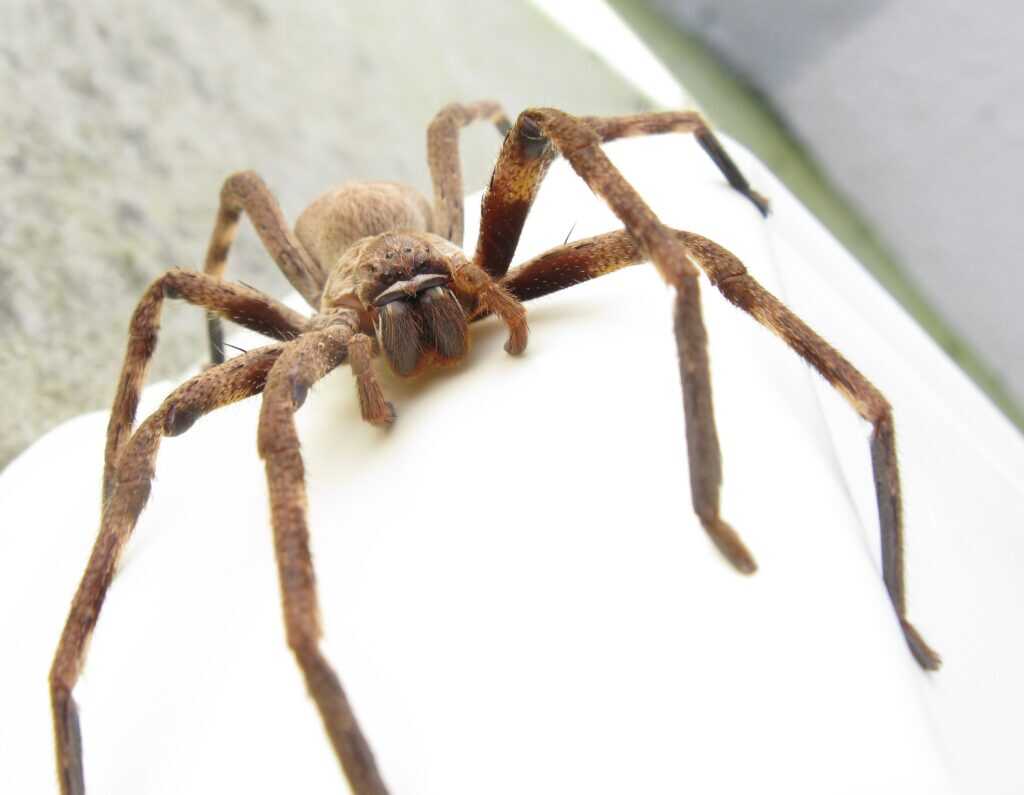
Huntsman Spiders — Vehicles & Homes
Why do Huntsman spiders hide behind car sun visors in Australia?
The biology of why Huntsman spiders love your car
Huntsman spiders — belonging to the family Sparassidae — are fundamentally different from the web-building spiders most Australians are more familiar with. They do not construct webs. They hunt by running, using their speed, strength, and highly sensitive leg vibration receptors to locate and chase down prey. Because they don't have the passive food-capture mechanism of a web, Huntsman spiders spend the daylight hours completely concealed in a crevice that offers three things: darkness, a narrow entrance, and thermal stability.
Your car provides all three in abundance. The gap between the sun visor and the roof lining is a narrow, dark space that maintains a relatively stable temperature compared to exposed surfaces. The space behind the dashboard, inside the door trim, beneath the seat rails, and inside the rear parcel shelf all offer equally suitable harbour. During a nocturnal foraging excursion, a Huntsman spider exploring your driveway, garage, or carport will enter an open car window or door gap, investigate the interior for prey, and if dawn approaches before it exits, it will simply find the most suitable crevice and wait for darkness to return.
The engine bay is another common harbour, particularly on cars with plastic under-bonnet trim panels that create sheltered, warm voids adjacent to the battery housing and fuse boxes. A spider in the engine bay presents no driving risk — until it relocates to the passenger compartment through a firewall gap when the engine heats up during driving.
When it goes wrong: documented incidents
A driver crashed their vehicle directly into Lake Cathie after a large Huntsman spider emerged and jumped onto their arm while driving. Emergency services attended the incident. The driver sustained minor injuries. The spider was not interviewed.
A woman abandoned her car on the side of a major Sydney road after a Huntsman appeared on her windscreen while driving. She called for assistance. A passing motorist with insect spray resolved the situation. The car was left running in a clearway for approximately 40 minutes.
A viral video recorded a large Huntsman clinging to the sun visor of a vehicle for a 20-minute drive. The driver completed the journey despite the spider — which remained motionless throughout, as Huntsman spiders typically do when they cannot immediately escape — and the video circulated globally as a demonstration of Australian driving conditions.
These incidents are not anomalies. They are a direct consequence of the Huntsman's biology: a spider concealed behind a sun visor will remain motionless throughout a normal drive. But when the visor is deployed — to block morning or afternoon sun — the sudden movement and light exposure triggers the spider's defensive startle response, and it moves fast, in a direction that may be directly toward the driver.
The combination of a moving vehicle, a driver with a sudden large spider on or near their face, and the involuntary flinch response that the human nervous system produces in this situation creates a genuine road safety risk.
The biology of the startle encounter
Huntsman spiders move exceptionally fast — among the fastest of all spider species — and their movement pattern is erratic and multidirectional in a way that the human visual system finds particularly alarming. Unlike a cockroach or a small spider that retreats in a predictable direction, a startled Huntsman spider on a sun visor will make multiple rapid direction changes in the first few seconds of light exposure, potentially landing on the dashboard, the steering wheel, or the driver themselves before exiting the vehicle or finding a new harbour.
This movement pattern is involuntarily perceived as a high-threat stimulus by the human startle reflex, triggering an immediate physical response that is entirely involuntary and incompatible with controlled vehicle operation.
Why Huntsman spiders enter homes — and garages — in South East Queensland
Huntsman spiders are not pests in the ecological sense — they are predators that control insect populations, and in an outdoor context they are entirely beneficial. The problem arises when their search for sheltered harbourage brings them indoors, into garages, into stored garden equipment, into footwear, and into vehicles.
In South East Queensland, warm evenings throughout most of the year keep Huntsman spiders active at night year-round. They are drawn toward residential properties by the insect activity concentrated around exterior lighting, and once in the general vicinity of the house, they explore every available gap, crevice, and opening. Gaps around doors and windows, weep holes in brickwork, open garage doors, and ventilation openings all provide entry points into the building envelope.
How to reduce Huntsman spiders in and around your car
Park in a sealed garage where possible
A sealed garage with a closed roller door significantly reduces the opportunity for Huntsman spiders to access your vehicle overnight. Ensure the garage itself is treated — a spider-heavy garage will eventually populate the vehicles stored inside it.
Keep car windows closed when parked
Even a small gap in a window provides sufficient entry for a Huntsman. Ensure all windows and sunroofs are fully closed before leaving the vehicle unattended overnight, particularly when parked under trees or near garden beds.
Check the sun visor before driving
Develop the habit of briefly deploying and retracting the sun visor from outside the vehicle — or through the open window — before entering. This simple check takes three seconds and eliminates the risk of discovering a sun visor passenger while at speed.
Professional exterior spider treatment
Jets Pest Control's general pest treatment covers spiders as part of the full internal and external application. The external perimeter treatment reduces the spider population active around your garage, carport, and vehicle parking area, significantly lowering the probability of vehicular entry. The treatment is safe for both humans and pets once the product has dried.
Is it a Huntsman — or something more dangerous?
Australia has several species of large, fast-moving spider, and correct identification matters. The Huntsman's lack of medical significance makes it far less concerning than the misidentified alternatives.
- Huntsman (Sparassidae): Very large leg span (10–15cm), flat body profile, legs extended laterally (crab-like), runs fast. Low medical risk. Photophobic — retreats from light.
- Redback (Latrodectus hasselti): Small to medium size, distinctive red or orange stripe on black abdomen. Builds irregular web in sheltered sites. High medical significance — seek treatment for confirmed bites.
- Eastern Mouse Spider (Missulena bradleyi): Medium size, bulky body, large fangs visible from front. Ground-dwelling, burrow-based. Venom considered potent — seek medical attention for bites.
- Garden Orb-weaver (Eriophora transmarina): Large, round abdomen, builds classic circular web. Common on fence lines and pergolas. Low medical risk, non-aggressive.
Jets Pest Control's general pest treatment covers spiders — including Huntsman species — as part of the full internal and external residual application across Ipswich and Brisbane. Treatment from $185 for a standard residential property. Queensland Health licensed. Safe for family and pets once dry. 12-month limited warranty.
Spider-free home and garage — from $185
Full interior and exterior residual treatment. Covers Huntsman spiders, Redbacks, and all other common species. Ipswich and Brisbane.
Book TreatmentFrequently asked questions
Why do Huntsman spiders hide in cars in Australia?
Are Huntsman spiders dangerous?
How do I stop Huntsman spiders getting into my car?
What should I do if I see a spider while driving?
What is the biggest Huntsman spider found in Queensland?
How long can a Huntsman spider survive inside a car?
Ready to protect your home?
Serving Ipswich and South East Queensland — fixed prices, no hidden extras, 10% off for Seniors, Pensioners, and ADF members.
Call 1300 566 569
