
DIY Termite Treatment — Why It Fails
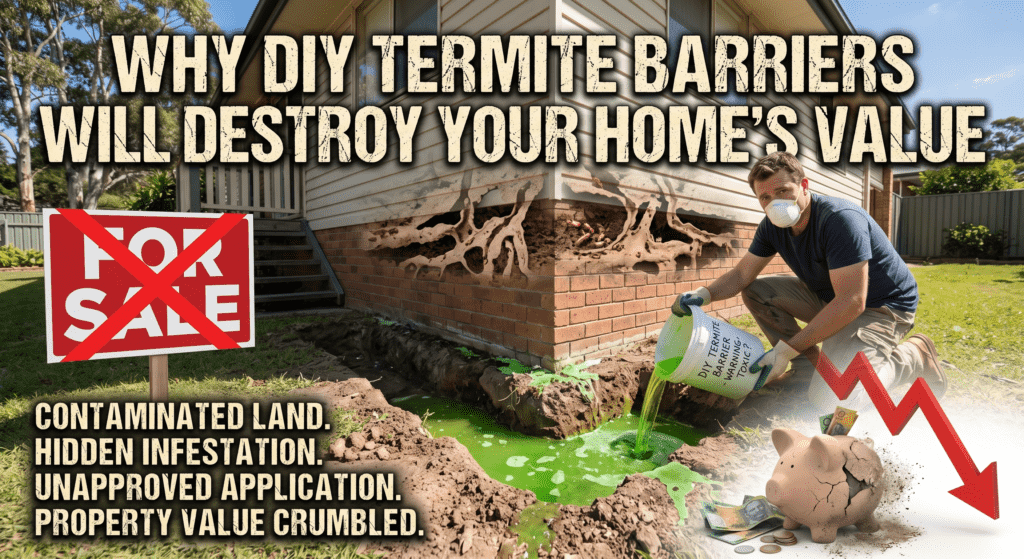
Why DIY chemical termite barriers will destroy your home's value
Australian hardware stores sell termite products that appear to offer professional-grade protection. They do not. DIY termite barriers create a false sense of security while the colony adapts, reroutes, and continues feeding. By the time the homeowner realises the treatment failed, the structural damage bill has compounded exponentially.
The biology of why DIY treatments fail
Every DIY termite product on the Australian market shares the same fundamental limitation: it cannot penetrate the sealed, subterranean gallery system through which Coptotermes acinaciformis travels. These termites never expose themselves to open air. They forage through sealed mud tubes beneath the soil and inside wall cavities, never coming into contact with a surface spray unless that spray is specifically injected into the soil at the correct concentration and continuity to form a genuine chemical barrier zone.
Hardware store barrier products contain active chemicals at dilutions far below professional-grade formulations, applied by homeowners without the soil injection equipment, site assessment knowledge, or product handling licence required to achieve a continuous treatment zone. Even where active chemical reaches the soil, Coptotermes acinaciformis workers detect the chemical signature through their antennae and begin to avoid that section of soil, foraging around the treated area within days.
When a DIY treatment disturbs part of the colony's foraging path, workers seal the affected gallery sections and reroute. The colony now enters your structure through a different, untreated access point. You have not eliminated the threat — you have redirected it to a location you are now unaware of. The queen is unaffected. The infestation continues.
Three common DIY approaches and why each fails
Contact insecticide sprays applied to skirting boards, subfloor timbers, and wall bases kill any termite workers that walk across the treated surface. Because subterranean termites travel inside sealed galleries — never on open surfaces — contact sprays have virtually no effect on active foraging activity. They may kill occasional stray workers, but the foraging tunnel system continues operating inches below the treated surface, completely unaffected.
Some retail products use repellent chemicals — often synthetic pyrethroids — that termites can detect and avoid. When applied to soil around a structure, these products do not kill termites; they signal the colony to avoid that soil section. The colony then probes the barrier for gaps — and DIY application almost invariably creates gaps, through uneven application, insufficient depth, or missing treatment around penetrations. The termites find the gap within weeks and continue feeding.
Retail bait stations are placed in the soil around the property perimeter. Termites are supposed to find the bait, consume it, and carry it back to the colony. Professional bait systems — such as Sentricon Always Active — use specifically engineered cellulose matrices and insect growth regulators that are highly palatable to termites and proven to achieve colony elimination. Retail bait products use inferior bait matrices that are far less attractive to termites than the structural timber they are already consuming.
How DIY treatment destroys your property value
The financial damage from DIY termite treatment does not just come from the continuing infestation. It compounds in several specific ways that permanently affect your property's value and saleability.
1. Voided professional warranty
If you have previously had a professional chemical barrier installed — or if you intend to install one — any DIY chemical application in the same treatment zone can permanently void the manufacturer's warranty. Termidor HE's warranty requires that only licensed applicators handle the product in the treatment zone. Evidence of unlicensed chemical application voids all warranty coverage, leaving you with an unprotected property and no recourse against the chemical manufacturer.
2. Increased remediation cost
When a licensed timber pest inspector is called in after a failed DIY attempt, the job is significantly more complex and expensive than if it had been addressed correctly from the outset. The colony has adapted its foraging routes. Affected gallery sections have been sealed. The colony may have split into multiple secondary nesting locations. A complete professional remediation — soil treatment, colony elimination strategy, structural inspection — typically costs more than double the original professional treatment would have.
3. Disclosure obligations on property sale
In Queensland, sellers have disclosure obligations regarding known defects and pest activity. A property with documented DIY termite treatment — and no professional inspection report confirming successful remediation — is a significant red flag for buyers and their conveyancers. Building inspectors specifically note evidence of DIY chemical treatment in pre-purchase reports. This directly affects buyer confidence and negotiating position, often costing far more on the sale price than a professional treatment would have cost.
Termidor HE barrier installations by Jets Pest Control — a certified BASF Accredited Applicator — include soil injection at correct concentration and depth, continuous treatment around the full building perimeter including all penetrations, a written completion certificate, and manufacturer-backed warranty documentation. This is the standard that protects your home and its value. It cannot be replicated with a hardware store product. See our current pricing for barrier installation costs.
What professional protection actually involves
A professional chemical termite barrier is a continuous zone of treated soil created by injecting Termidor HE at precise intervals and depths around the full perimeter of the building, under the slab, around all penetrations (plumbing, conduit, drainage), and under any concrete paths or attached structures. The continuity of this zone is everything — a single gap the width of a mud tube is sufficient for a Coptotermes acinaciformis colony to exploit.
Achieving genuine continuity requires soil injection equipment, site assessment experience, detailed knowledge of building construction type, and the Queensland Health pest management licence that authorises use of Schedule 7 Dangerous Poisons. None of this is achievable with retail products or without a licence. Termite control in Brisbane and Ipswich requires the same professional standard — the colony does not respect DIY effort.
Professional Termidor HE barrier from $2,500
Certified BASF Accredited Applicator. Manufacturer-backed warranty. One treatment done correctly — protecting your home's value for eight years.
Get a QuoteFrequently asked questions
Does DIY termite treatment actually work?
Is DIY termite treatment legal in Queensland?
Can a DIY termite treatment void my home's warranty or insurance?
What does a professional termite chemical barrier cost?
How long does a professional termite barrier last?
Will a termite barrier affect my garden or pets?
Ready to protect your home?
Serving Ipswich and South East Queensland — fixed prices, no hidden extras, 10% off for Seniors, Pensioners, and ADF members.
Call 1300 566 569
