
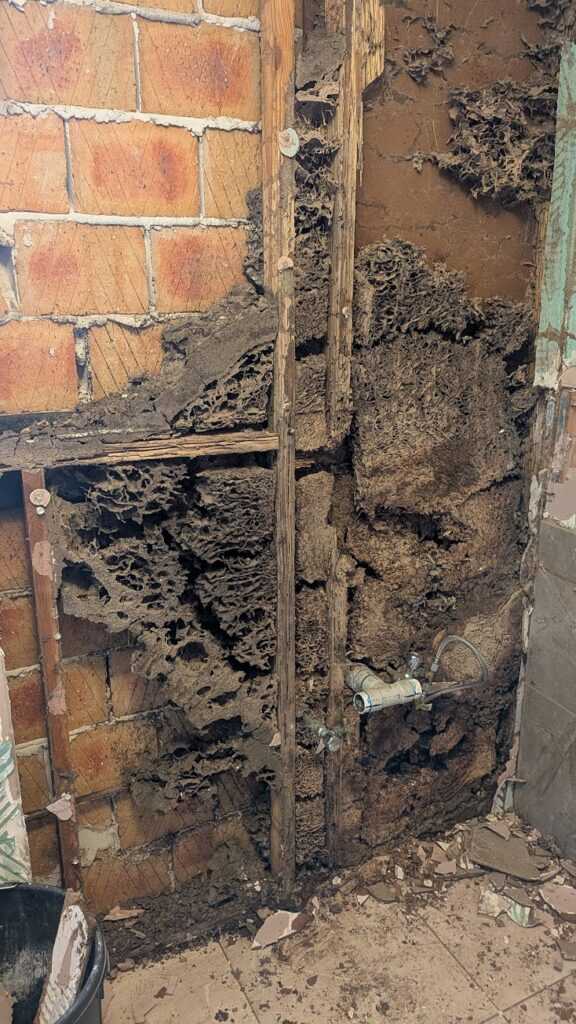
Termite Detection — Wall Cavities
Signs of a million-termite nest hidden in your Brisbane wall cavity
Coptotermes acinaciformis — the most destructive termite species in South East Queensland — consumes timber from the inside out, leaving the outer surface completely intact. A colony of one million or more insects can be active inside your wall for over a year before you see a single visible sign. Termite control in Brisbane starts with early detection.
Why termites in wall cavities are almost impossible to detect without professional tools
Every biological instinct of Coptotermes acinaciformis — the species responsible for the vast majority of structural termite damage in South East Queensland — is oriented toward concealment. They do not build external mounds. They do not create visible entry points. They seal every gallery they create with a mixture of mud, saliva, and faecal matter that perfectly matches the surrounding surface in both colour and texture.
Their foraging strategy involves approaching a structure from underground, entering through soil-to-timber contact points that are often completely inaccessible without lifting floorboards or cemoving wall linings, and then spreading laterally through the wall framing system. By the time any external sign is visible, the infestation has typically been active for 12 months or more.
The result is that the standard advice — "look for mud tubes" — is often useless for wall cavity infestations. The mud tubes are inside the wall. The damage is inside the wall. The termites are inside the wall.
The signs — ranked by urgency
Not all signs carry the same weight. Some indicate an active, severe infestation requiring immediate investigation. Others suggest conducive conditions or earlier damage. Here is how to read what you find.
Hollow-sounding timber when tapped
Use your knuckles to rap firmly along skirting boards, door frames, and walls. Solid timber produces a dense, flat sound. Termite-damaged timber produces a hollow, papery echo. A noticeable difference in a small area is a strong indicator of active excavation immediately behind the surface.
Mud tubes on walls, stumps, or subfloor piers
Subterranean termites build mud tubes — pencil-width tunnels of compacted earth and saliva — to travel between the soil and their food source while maintaining humidity. Tubes on internal walls, external brickwork, or subfloor piers are a definitive sign of active or recently active termite movement. Never break a tube open — it triggers colony retreat.
Paint bubbling or blistering with no moisture source
Termites require high moisture to survive, and colonies inside wall cavities generate significant localised humidity. This moisture migrates outward, lifting and blistering paint from the inside. If paint is bubbling on a wall that has no plumbing behind it and no external moisture intrusion, suspect termites first.
Doors or windows suddenly sticking or jamming
Termite-damaged wall studs lose their structural rigidity and begin to deflect under load. This causes door frames and window frames to shift slightly out of square, making doors difficult to open or close. If a door or window that previously worked smoothly is suddenly jamming for no apparent reason, check the surrounding frame with a tap test immediately.
Frass or termite droppings near timber
Frass — small, pellet-shaped droppings from drywood termites, or small granular mounds of soil from subterranean species — may accumulate near infested timber. Note that Coptotermes acinaciformis does not typically push frass out of galleries; this sign is more common with drywood termite species and may indicate a secondary or historical infestation.
Earthy or musty smell from floors or walls
Active termite colonies produce a faint but distinctive smell — often described as a musty or earthy odour, similar to damp soil or mould. If you notice this smell emanating from a wall or floor area with no obvious water damage or ventilation issue, it warrants professional investigation.
Discarded wings near windows or doors
Termite alates — the reproductive, winged caste — swarm in warm, humid conditions, typically in spring and early summer after rain. They shed their wings immediately after landing. A cluster of small, identical wings near a window sill or door frame indicates a termite swarm has occurred in or near the building. This does not confirm an active infestation inside the wall, but warrants an immediate inspection.
Timber in direct contact with soil in the garden
Sleepers used for garden edging, fence posts set directly in soil, and timber decks with posts embedded in the ground provide direct foraging access from ground-dwelling termite colonies to your home's structure. These are conducive conditions rather than active signs, but they are among the most common entry points identified during timber pest inspections in SEQ.
Live trees or dead stumps close to the house
Coptotermes acinaciformis is a central-site nester that frequently establishes its primary colony inside living trees, particularly eucalyptus, Lilly Pilly, and mature shade trees common in suburban Brisbane and Ipswich gardens. A tree within 50 metres of the house with a hollow or decaying base is a potential colony location that warrants thermal investigation during your inspection.
If you suspect termites in a wall, do not spray aerosol insecticide into the area. Hardware store sprays kill foraging workers but do not reach the queen. The colony detects the chemical and immediately seals its galleries, retreating deeper into the wall system and splitting into secondary nesting locations. You will not solve the problem — you will make it harder and more expensive to fix.
How professionals find what you cannot see
The most significant limitation of a standard visual termite inspection is that it cannot see inside walls. A thorough licensed inspector will tap timber, probe suspect areas, and check all accessible voids — but wall linings remain a significant blind spot. Two technologies bridge this gap.
FLIR thermal imaging
Thermal imaging cameras detect temperature differences across wall surfaces. Active termite colonies generate significant localised heat from metabolic activity, and they produce high moisture within their galleries that creates thermal contrast against surrounding dry timber. A thermal camera scan can reveal the precise location and approximate size of an active colony inside a wall without a single hole being drilled. If the colony is confirmed, professional treatment must begin within 24 to 48 hours.
Termatrac T3i radar technology
The Termatrac T3i uses microwave radar to detect movement of insects inside building materials through non-invasive scanning. The device is held against a wall surface and measures the frequency shift caused by termite movement within. It provides real-time confirmation of whether termites are currently active in a specific location, as distinct from historical damage or inactive gallery systems.
Jets Pest Control deploys both FLIR thermal imaging cameras and Termatrac T3i radar devices during targeted timber pest investigations. Our licensed inspectors — with over 35 years of combined experience in timber pest management — use these tools to provide definitive answers about active termite presence without unnecessary destructive access to your walls. Book a thermal inspection across Ipswich and Brisbane.
What to do right now if you suspect termites in your walls
If any of the signs above are present, or if it has been more than 12 months since your last professional timber pest inspection, book an investigation immediately. The cost of an inspection — from $185 — is insignificant compared to the structural repair bill that awaits on the other side of a delayed diagnosis. In South East Queensland, where one in three homes in high-risk zones will experience a termite attack during the building's lifespan, an annual inspection is not a luxury. It is the only financial protection available to you, because your home insurance will not pay for what termites destroy.
Suspect termites? Book a thermal investigation
FLIR thermal imaging and Termatrac radar across Ipswich and Brisbane. Find what's inside your walls — before it's too late.
Book NowFrequently asked questions
What are the first signs of termites in a wall cavity?
How do I know if termites are active in my walls right now?
Can termites be in my walls without any visible signs?
What should I do if I find mud tubes or termite damage in my home?
How much does a termite nest in a wall cavity cost to fix?
How long can termites go undetected in a house?
Ready to protect your home?
Serving Ipswich and South East Queensland — fixed prices, no hidden extras, 10% off for Seniors, Pensioners, and ADF members.
Call 1300 566 569
