
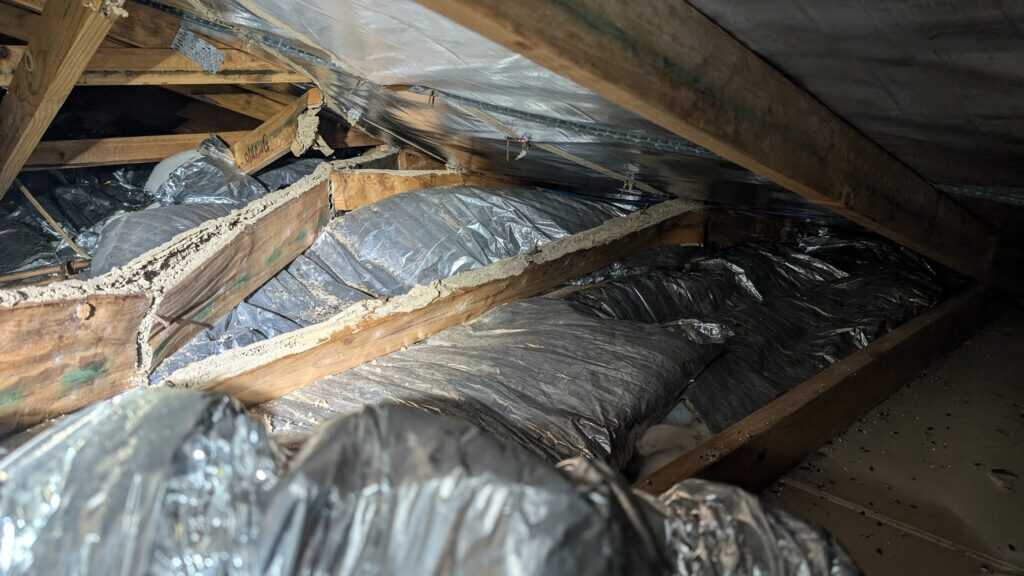
Termite Damage & Home Insurance Queensland
Are termite damage repairs covered by home insurance in Queensland?
Standard home insurance policies in Australia explicitly exclude termite damage. Around 32% of home insurance claims are denied due to pest-related exclusions — and most homeowners discover this only after the damage is already done.
The short answer every Queensland homeowner needs to know
No. Home and contents insurance policies in Australia do not cover termite damage. They never have. Insurers classify termite infestation as a maintenance issue — something that develops gradually over time — rather than a sudden, unforeseen event. Because insurance is designed to cover unexpected disasters, the slow, silent destruction caused by termites falls entirely outside the scope of standard policies.
This is not buried in fine print. Pest damage exclusions are a standard, explicit clause in every major insurer's product disclosure statement. But because most homeowners never read their product disclosure statement in detail, the reality hits hard at precisely the worst moment: when a building inspector finds hollowed-out wall frames during a pre-sale report, or when a floor collapses without warning.
South East Queensland has one of the highest termite risk profiles in the country. The warm, humid climate and clay-rich soils of the Ipswich and Brisbane region create near-ideal conditions for subterranean termite colonies. The CSIRO estimates termites cause between $1.3 billion and $1.5 billion in property damage across Australia every year — almost none of it insured.
Why termites are specifically excluded from insurance policies
Insurance companies draw a clear line between events that are sudden and accidental — fire, storm, flood — and events that are gradual and preventable. Termite infestations belong firmly in the second category. Insurers argue, and the courts have consistently agreed, that a homeowner exercising reasonable care and maintenance would detect and address a termite problem before it causes catastrophic structural damage.
This logic creates a paradox that disadvantages homeowners: termites are specifically evolved to be undetectable. The most destructive species in South East Queensland, Coptotermes acinaciformis, does not build visible mounds and does not create obvious external evidence of activity. A colony of over one million insects can silently consume the structural timbers of a home for years before a homeowner notices anything wrong.
Regardless of this biological reality, the exclusion stands. The financial burden falls entirely on the property owner.
Your policy almost certainly contains language like: "We do not cover loss or damage caused by insects, vermin, or pests, including but not limited to termites, borers, and rodents." Read your product disclosure statement. The exclusion is unambiguous and universal across Australian home insurance products.
How to check if your current policy excludes termite damage
Every insurer is required by law to issue a product disclosure statement that clearly outlines what is and is not covered. The easiest way to confirm your exclusions is to search your product disclosure statement document for the words "termite", "pest", "vermin", or "insect". You will almost certainly find a clear exclusion clause.
The Insurance Council of Australia provides a publicly available guide on what standard home insurance typically covers. While the council notes that coverage varies between products, pest damage exclusions are standard across the industry. If you cannot locate your product disclosure statement, contact your insurer directly and ask them to confirm in writing whether termite damage is covered. Keep that written response on file.
If you are a landlord, also check your landlord insurance policy separately — many landlord policies contain the same exclusion, meaning termite damage to a rental property is equally uninsured regardless of who is in residence. For a full breakdown of landlord and tenant responsibilities, read our guide on termite control for Queensland properties.
What your policy does and does not cover
| Damage or Event | Covered? |
|---|---|
| Storm damage to roof and walls | ✓ Yes |
| Fire damage to structural timbers | ✓ Yes |
| Termite damage to wall frames and floor joists | ✗ No |
| Structural collapse caused by termite activity | ✗ No |
| Cost of termite treatment and barrier installation | ✗ No |
| Temporary accommodation during termite-related structural repairs | ✗ No (if caused by termites) |
| Cosmetic damage (paint, plaster) from other causes | ✓ Usually yes |
What termite damage actually costs in Queensland
The Australian Institute of Building Surveyors and major lenders consistently report that termite damage is the most costly non-weather-related threat to residential buildings in Australia. In South East Queensland — one of the highest-risk zones in the country — the financial exposure is very significant.
- Minor infestations affecting skirting boards, architraves, and isolated timber panels: $2,000 to $5,000 in repairs, plus treatment costs.
- Moderate infestations where floor joists, wall studs, or window frames are compromised: $7,000 to $15,000.
- Severe structural damage involving load-bearing walls, roof trusses, or significant subfloor framing: $30,000 to $100,000 or more, with some properties requiring full demolition.
None of these costs are recoverable from your insurer. Every dollar comes out of the homeowner's pocket — or in many cases, forces a distressed property sale. The CSIRO estimates that termites cause between $1.3 billion and $1.5 billion in property damage across Australia every year, with Queensland accounting for a disproportionate share due to our climate.
The biology behind why the damage is so severe before you find it
Coptotermes acinaciformis, the dominant subterranean termite species across South East Queensland, operates with a single biological imperative: find and consume cellulose. Their colonies are central-site nesters, meaning the queen and the primary nest remain hidden inside a living tree, tree root, or underground structure — often 50 to 100 metres from the house being attacked. Worker termites travel along hidden underground galleries and through internal wall voids, consuming timber from the inside out while leaving the outer surface intact and undamaged in appearance.
A mature colony containing one million to several million individual insects can consume up to 500 grams of dry timber per day. Over a 12-month period without detection, that equates to the complete structural destruction of a standard wall frame. The outer paint surface remains unchanged. The wall is hollow. The floor joist is a shell.
This is precisely why insurance exclusions feel so unjust to homeowners: there was no visible warning sign, and by the time the wall failed, the colony had been actively feeding for years.
How to protect yourself financially from termite damage
Because insurance provides no protection whatsoever, prevention and early detection are the only viable financial strategies available to Queensland homeowners. Australian Standard AS 3660.2 recommends annual visual timber pest inspections for all properties in high-risk zones — which includes the entirety of South East Queensland. This is not merely a guideline; it is the benchmark against which courts and lenders assess whether a homeowner exercised reasonable care over their property.
Annual visual termite inspection
A licensed timber pest inspector examines all accessible areas of the property for evidence of termite activity, conducive conditions, and prior damage. Under AS 3660.2, this inspection covers the subfloor, roof void, external perimeter, and all internal rooms. Jets Pest Control offers visual termite inspections from $185 for apartments up to $385 for larger homes across Ipswich and Brisbane.
Thermal imaging and radar investigation
Where visual evidence is inconclusive, advanced diagnostic tools — specifically FLIR thermal imaging cameras and Termatrac T3i radar devices — allow inspectors to detect active termite movement and moisture anomalies inside wall cavities without destructive access. Jets Pest Control deploys both technologies on targeted investigations as part of our comprehensive termite inspection service.
Professional chemical barrier installation
Where termites are detected or the property is assessed as high-risk, a licensed installer applies a continuous chemical barrier in the soil around and beneath the building. Termidor HE, when correctly applied by an accredited installer, provides documented protection and carries a manufacturer's warranty. Learn more about our termite barrier installation service.
Document everything you do
Keep all inspection reports, treatment records, and contractor invoices filed safely. In the event of a future property sale, mortgage renegotiation, or dispute with a purchaser, documented annual inspections demonstrate due diligence and significantly strengthen your legal position. Buyers increasingly request evidence of termite inspection history as part of their pre-contract due diligence.
Does a termite warranty replace insurance?
Not entirely, but it is the best available alternative to standard insurance for this specific risk. Some manufacturers and licensed pest management companies offer warranty products that cover re-treatment costs — and in some cases structural repair — following a professionally installed chemical barrier. These warranties are conditional on annual inspections being maintained, and they are narrower in scope than general home insurance. However, they provide meaningful, documented financial protection for one of the highest-probability risks your property faces.
Jets Pest Control is a certified BASF Accredited Applicator for Termidor HE, enabling us to issue manufacturer-backed warranty documentation upon completion of qualifying termite barrier installations. This is the closest thing to insurance that currently exists for termite damage in Australia.
If you cannot remember the last time your property had a professional termite inspection, that is the most important thing to address. Queensland's climate means termite colonies can establish and cause significant structural damage within 12 to 18 months. Book an inspection with Jets Pest Control — our team serves Ipswich, Brisbane, and surrounding South East Queensland suburbs. View our full price list here.
Book a termite inspection from $185
Do not wait until your insurer tells you what you are not covered for. An annual inspection is the single most effective financial protection available to Queensland homeowners.
Book Your Inspection TodayFrequently asked questions
Does home insurance cover termite damage in Queensland?
What percentage of insurance claims are denied due to termite exclusions?
How much does termite damage cost to repair in Queensland?
How do I protect myself financially from termite damage?
Is a termite inspection required when buying a house in Queensland?
Can I get insurance that covers termite damage?
Ready to protect your home?
Serving Ipswich and South East Queensland — fixed prices, no hidden extras, 10% off for Seniors, Pensioners, and ADF members.
Call 1300 566 569
